On August 4, 2026, Ghana’s President John Dramani Mahama addressed a Special Joint Sitting of Jamaica’s Houses of Parliament at Gordon House in Kingston, during a four-day state visit. The address delivered one of the most direct head-of-state endorsements yet of a policy category CRDEA has spent years appealing to African governments to adopt: a formal legal right of return for descendants of enslaved Africans.
President Mahama told Jamaican legislators that repatriation is a right belonging to all persons of African descent who wish to return and settle on the continent. As he put it to lawmakers, “Repatriation is not an act of kindness.”
From the Right of Abode Act to a Homeland Return Bill
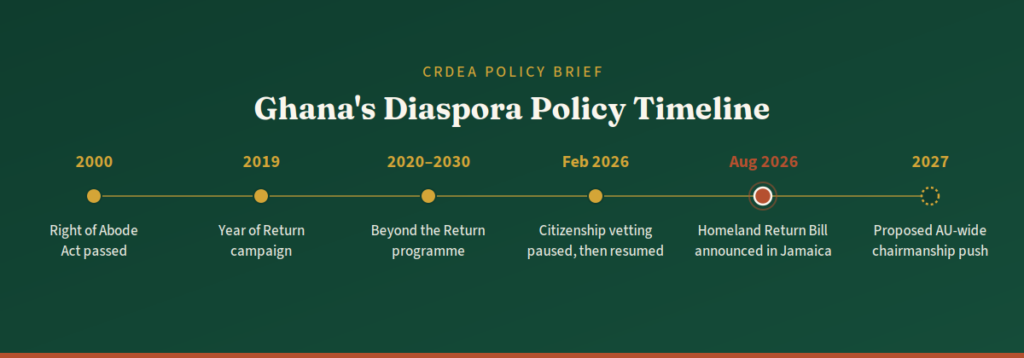
Ghana already has a legal framework for this. The Right of Abode Act, passed in 2000, allows people of African descent to apply for permanent residence, letting them live and work in Ghana indefinitely without a work permit once eligibility is confirmed. The framework was reinforced socially through the 2019 Year of Return campaign and the Beyond the Return programme that followed, a ten-year diaspora engagement plan running through 2030.
In practice, the pathway has been uneven. Ghana briefly paused vetting for its citizenship-by-naturalization route for the Historic Diaspora Community in February 2026 to reorganize processing, before resuming interviews at Accra’s Du Bois Centre later that month. Applicants have also pointed to cost and processing time as recurring friction points along the existing tracks.
Mahama’s announcement in Kingston addressed that gap directly. He said his government is now considering a new Homeland Return Bill that would codify residence and citizenship pathways for the global African family, going beyond the Right of Abode Act’s residency-only status toward a clearer, formalized route. He also signaled an intention to take the proposal continental: he plans to champion right-of-return legislation across the African Union when he assumes the AU chairmanship in 2027, urging member states to adopt equivalent frameworks.
What It Signals for CRDEA’s Right of Abode Framework
Ghana’s move matters for CRDEA’s work because it validates, at head-of-state level, the policy category behind our own Right of Abode framework: a formal, legally codified pathway home for descendants of enslaved Africans, framed as a matter of historical justice rather than discretionary immigration policy.
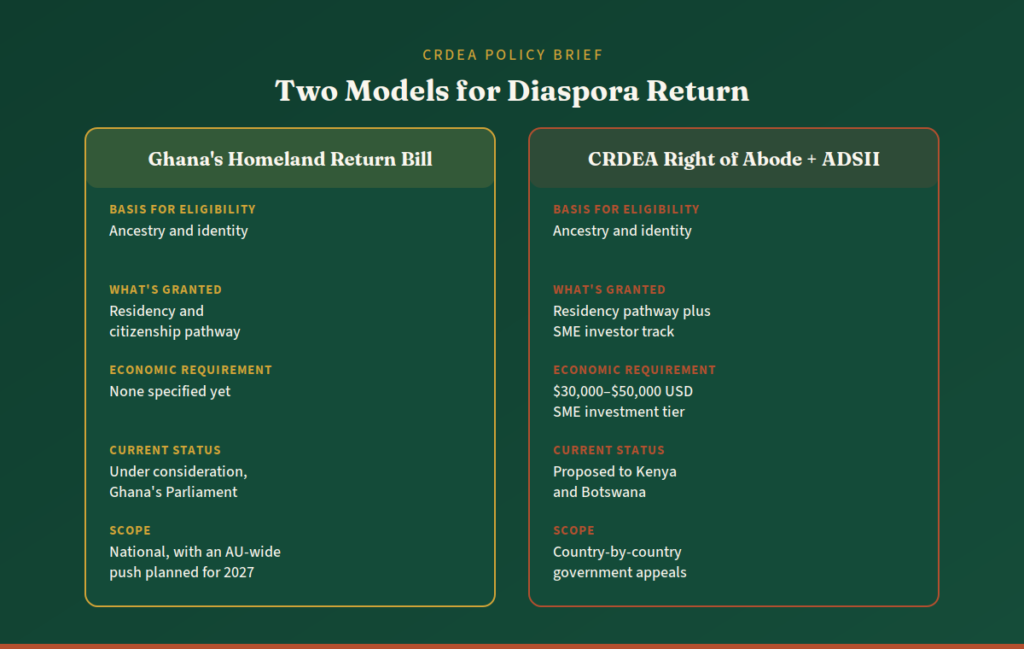
Ghana’s current proposal differs from CRDEA’s model in structure. The Homeland Return Bill, as described so far, centers on ancestry and identity as the basis for residence and citizenship. CRDEA’s framework, and its companion African Diaspora SME Investment Initiative (ADSII), pairs that same right-of-return principle with a defined economic contribution tier: a $30,000 to $50,000 USD SME investment band designed to give host governments measurable, verifiable economic return alongside the historical case for return. It is the model CRDEA has proposed to Kenya’s Ministry of Foreign and Diaspora Affairs and to Botswana’s Ministry of Trade and Entrepreneurship.
Ghana’s announcement strengthens CRDEA’s case rather than replacing it. A government the size and standing of Ghana publicly framing repatriation as a matter of right gives every ministry CRDEA has appealed to a live precedent to point to, and gives CRDEA firmer ground to argue that an investment-anchored SME tier is a natural next step once a state accepts the underlying right-of-return principle.
What Comes Next
The Homeland Return Bill has not yet been tabled or passed. Ghana’s government has indicated updated guidelines will follow, and the legislation itself is still being drafted. For CRDEA, the more consequential detail is Mahama’s stated intention to press the proposal through the African Union in 2027. If even a handful of member states move toward equivalent legislation, the diplomatic ground CRDEA has been working, appealing to individual ministries one at a time, starts to shift toward a continental norm rather than a series of isolated asks.
CRDEA will track the bill’s progress through Ghana’s Parliament and report on any African Union-level movement as Mahama’s chairmanship approaches.
The Coalition for the Repatriation of Descendants of Enslaved Africans (CRDEA) advocates for formal immigration pathways and permanent residency for the diaspora returning to the continent. Our objective is to integrate diaspora human capital, investment, and expertise with continental resources to drive sustainable economic empowerment and Pan-African development.
FAQ
What is Ghana’s Homeland Return Bill?
It is proposed legislation, announced by President John Dramani Mahama on August 4, 2026, that would codify residence and citizenship pathways for people of African descent in the diaspora. It has not yet been drafted into a formal bill text or tabled in Ghana’s Parliament.
How is it different from Ghana’s existing Right of Abode Act?
The Right of Abode Act of 2000 grants eligible diaspora applicants permanent residence, allowing them to live and work in Ghana indefinitely without a work permit, but it stops short of citizenship. The Homeland Return Bill is intended to go further by formalizing clearer residence and citizenship pathways.
Has the Homeland Return Bill been passed into law?
No. As of this writing, it remains under consideration. Ghana’s government has said further guidelines and legislative detail will follow.
Why did President Mahama announce this in Jamaica rather than Ghana?
Mahama made the announcement during a four-day state visit to Jamaica, addressing a Special Joint Sitting of the Jamaican Parliament on August 4, 2026. The setting connected the proposal to CARICOM’s own reparatory justice agenda, which lists repatriation and resettlement as the second pillar of its Ten-Point Plan.
How does this compare to CRDEA’s Right of Abode framework and ADSII?
CRDEA’s framework shares the same right-of-return principle but adds a defined SME investment tier ($30,000 to $50,000 USD) through the African Diaspora SME Investment Initiative (ADSII), giving host governments a measurable economic rationale alongside the historical case for return. Ghana’s current proposal, as described, is ancestry and identity based rather than investment linked.
What happens when Mahama becomes African Union chairperson in 2027?
Mahama has stated he intends to push other AU member states to adopt equivalent right-of-return legislation during his chairmanship. CRDEA will be monitoring whether this translates into continental-level policy movement.
REFERENCES
- Jamaica Information Service. “Ghana President Supports Right of Return for African Diaspora.” August 2026. https://jis.gov.jm/ghana-president-supports-right-of-return-for-african-diaspora/
- Jamaica Gleaner. “Back to Africa: Mahama Revives Right of Return to Motherland with Ghana Citizenship Proposal for Diaspora.” August 5, 2026. https://jamaica-gleaner.com/article/news/20260805/back-africa-mahama-revives-right-return-motherland-ghana-citizenship-proposal
- Jamaica Observer. “Back to Africa.” August 5, 2026. https://www.jamaicaobserver.com/2026/08/05/back-to-africa-20260805-0746-366000/
- Ghana Ministry of the Interior. “Right of Abode.” e-Services Portal. https://www.mint.gov.gh/e-services-portal/right-of-abode/
- NewsGhana. “Ghana Suspends Citizenship Applications for Historical Diasporans.” February 2026. https://www.newsghana.com.gh/ghana-suspends-citizenship-applications-for-historical-diasporans/
