Kenya’s Diaspora Investment Gap: Paying Taxes With No Residency Path
Diaspora investors are already inside Kenya’s economy, whether the immigration system has a category for them or not. They pay income tax on Kenyan-registered income. They pay county land rates on property they hold outright, often bought years before any residency conversation began. They employ local staff, source materials from Kenyan suppliers, and reinvest profits back into their operations rather than repatriating them. None of this shows up as “investment” in the way Kenya’s current frameworks recognize it, because none of it clears the thresholds those frameworks were built around.
One founder working in Kenya’s agricultural sector describes the disconnect plainly. He settles a full tax bill and land rates each year, manages a working farm, and creates local employment, all while holding no residency status that reflects any of it. In a conversation about immigration policy, he recalls being told, in effect, that Kenya “has enough refugees” already. The comment says more about the state of the classification system than it does about the individual it was aimed at. A self-financed investor paying into the tax base and a person displaced by conflict are not the same population, legally or economically, yet the current framework has no third box to check.
This is not an isolated experience. Across the diaspora, a pattern repeats: individuals who hold Kenyan land, run registered businesses, or maintain long-term agricultural operations describe the same administrative blank spot. They are neither tourists passing through nor conventional foreign investors moving large capital through Nairobi’s commercial core. They are something the current system was never built to name, and in the absence of a name, officials sometimes default to the closest available label, however poor the fit.
Why Diaspora Investment Kenya Policy Hasn’t Caught Up
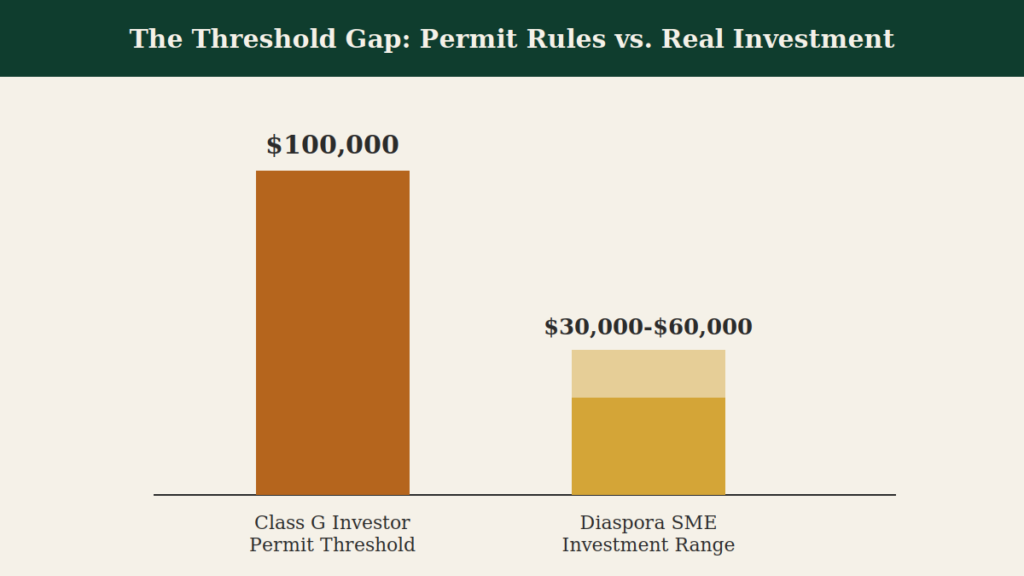
Kenya’s investor and residency thresholds were designed around large-capital inflows, typically in the USD 100,000 range required under the Directorate of Immigration Services’ Class G permit, concentrated in urban commercial activity. That threshold makes sense for foreign direct investment at scale. It does not describe the diaspora investor building a poultry operation, leasing agricultural land, or running a small agro-processing unit with a Kenyan business partner.
Diaspora SME investors typically operate in the USD 30,000 to 60,000 range. That is enough to start and sustain a working enterprise, but not enough to qualify under existing investor permit categories. The result is a structural gap. People who are already financially self-sufficient, already paying tax, already creating jobs, sit outside every formal pathway designed to recognize exactly that kind of contribution.
The Cost of Miscategorization
When a policy framework has no category for a group, that group gets folded into whichever category is closest at hand, however inaccurate. In this case, self-financed diaspora investors are sometimes treated, rhetorically if not legally, as an undifferentiated migration burden rather than as a distinct economic contributor.
This has real costs. Investors without a clear residency pathway cannot commit to multi-year planning with confidence. Capital that could scale gets held back. Employment that could be created stays smaller than it might otherwise be. Kenya, which has positioned itself as a continental leader on Pan-African economic integration, loses a straightforward opportunity to formalize a population that is, in practice, already here and already contributing.
There is also a cumulative dimension worth naming. Individual diaspora SME investments are modest by design, but the diaspora functions as a network, not a set of isolated actors. Once residency stability is in place for one cohort of investors, word travels through the same community ties that brought the first wave of capital in. What looks like a small pilot on paper is, in practice, a test of whether a much larger and more diffuse pool of diaspora capital can be mobilized on the strength of policy clarity alone.
What a Diaspora Investment Kenya Pathway Could Look Like
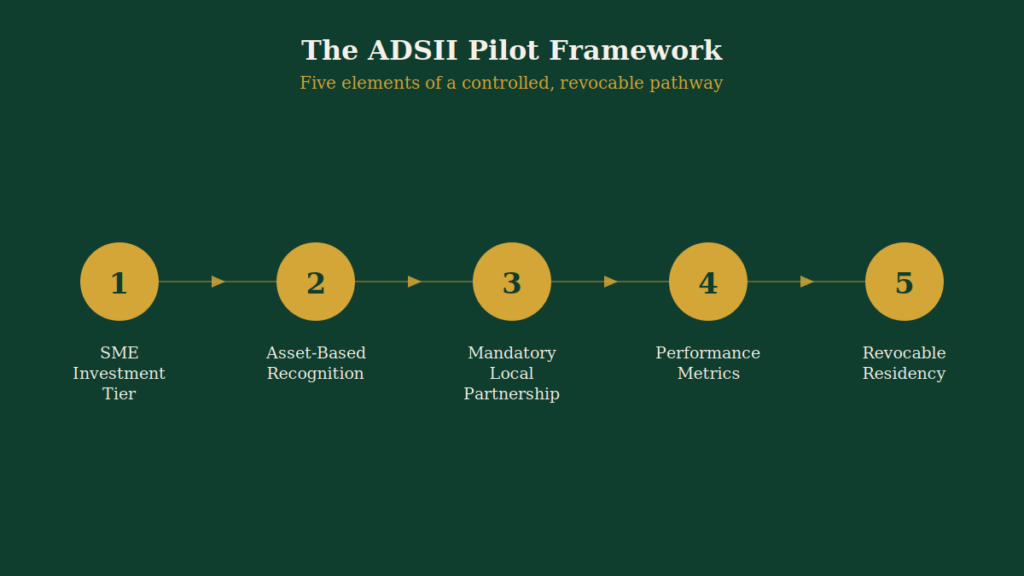
The African Diaspora SME Investment Initiative (ADSII) proposes a narrow, testable answer rather than a sweeping one. Its core elements include a dedicated SME investment tier, with qualifying capital in the USD 30,000 to 50,000 range, reflecting the real starting point for agricultural and rural enterprises rather than large-scale investor categories.
Asset-based recognition would allow land leases, livestock holdings, and agricultural equipment, subject to independent verification, to count toward the qualifying investment rather than requiring large upfront cash transfers alone.
Mandatory local partnership would require applicants to operate through documented, transparent joint ventures with Kenyan citizens or Kenyan-owned entities.
Defined performance metrics would tie residency status to measurable outcomes: jobs created, profit reinvested locally, tax compliance, and environmental and land-use compliance.
Full revocability would keep residency status conditional on continued performance, with KYC and AML screening applied throughout.
None of this asks Kenya to lower its guard. It asks Kenya to build a category precise enough to tell the difference between capital that is already working inside the economy and populations the current framework was never designed to describe.
Global Precedent for Diaspora Investment Pathways
Kenya would not be setting a precedent so much as catching up to one. Ghana’s Right of Abode framework, introduced in 2000, grants indefinite residence to people of African descent in the diaspora, and Liberia, Sierra Leone, and Benin have each built their own version of the same idea. The common thread across these models is specificity: a defined population, a defined pathway, and a defined set of obligations attached to the benefit.
Kenya itself already treats diaspora capital as strategically important, just through a different instrument. The country issued its first diaspora bond in 2011 and, according to industry reporting, is targeting up to $500 million in diaspora bond capital by 2026. A government that is actively courting diaspora capital through one channel has an obvious, low-risk opening to formalize the SME investors already putting that capital to work on the ground. Kenya’s Pan-African leadership position makes it a natural candidate to design its own residency pathway rather than adopt one wholesale.
There is also a rural development case that stands apart from the residency question entirely. Diaspora-aligned SME investment tends to concentrate in agriculture, livestock, and rural value chains, precisely the sectors that large-scale foreign capital tends to overlook in favor of urban commercial projects. A policy framework built around this reality would channel investment toward the parts of the country that most need it, not away from them.
The Path Forward
ADSII’s proposal, submitted to Kenya’s Principal Secretary for Diaspora Affairs, does not ask for an exemption from oversight or a shortcut around due diligence. It asks for a defined category, narrow enough to pilot, that finally distinguishes a self-financed diaspora investor from a population the current system was never built to address. Until that category exists, the tax receipts, land rate payments, and job creation happening quietly across Kenya’s diaspora-linked SMEs will keep going unrecognized by the very framework meant to account for them.
A pilot, by its nature, is reversible. A 12 to 18 month window with a defined cap on participating investors gives Kenya a low-risk way to measure whether asset-based, performance-tied residency produces the outcomes the framework promises, without committing to any permanent change in advance. If it does not deliver, the pilot ends and existing categories remain untouched. If it does, Kenya will have built a model worth studying rather than borrowing.
The Coalition for the Repatriation of Descendants of Enslaved Africans (CRDEA) advocates for formal immigration pathways and permanent residency for the diaspora returning to the continent. Our objective is to integrate diaspora human capital, investment, and expertise with continental resources to drive sustainable economic empowerment and Pan-African development.
References checked for this piece
Kenya Directorate of Immigration Services, Class G (Investor) Permit: https://immigration.go.ke/class-g-specific-trade-business-or-consultancy/ (confirms the USD 100,000 capital-proof threshold)
African Union, Diaspora & Civil Society Engagement, on Article 3(q) of the Constitutive Act: https://au.int/en/diaspora-civil-society-engagement
OHCHR, “Returning to Africa: People of African descent seek unique status” (Ghana, Liberia, Sierra Leone, Benin precedents): https://www.ohchr.org/en/stories/2025/06/returning-africa-people-african-descent-seek-unique-status
AFIS, “Capturing Africa’s elusive diaspora dollar,” on Kenya’s diaspora bond history and its reported $500M-by-2026 target: https://www.afis.africa/en/insight/pan-african-diaspora-investment-bonds/
