
Cost of Repatriating to Africa: What It Actually Takes to Move Home
The cost of repatriating to Africa is rarely the number people plan for. Most returnees budget the flight and the shipping container, then get surprised months later by a departure tax bill, a frozen pension, or a vehicle duty rule that only applies in the country they didn’t research. This article breaks down what Canada, the US, and the UK actually do to your finances when you leave, what Ghana, Kenya, Nigeria, and Trinidad and Tobago actually offer returning residents in exchange, and how to run the real numbers before you give notice on a lease.
What Does It Actually Cost to Repatriate to Africa or the Caribbean?
The visible costs are the easy part: flights, a shipping container, a few weeks of temporary housing on arrival. The costs that catch people off guard are the ones tied to what you’re leaving behind, not what you’re moving toward. A departure tax bill on unrealized capital gains. A pension that can’t simply follow you. A vehicle import rule that assumes duty-free treatment when the destination country charges VAT regardless.
For many in the CRDEA community, this move follows the silent struggle that follows return, the adjustment period after the emotional high of arrival wears off and the practical realities of income, healthcare, and cost of living set in. Getting the financial planning right ahead of time doesn’t remove that adjustment, but it does remove one layer of it.
Before shipping anything, budget for these categories:
- Shipping (luggage-only, air freight, or a 20ft or 40ft sea container)
- Vehicle costs, including destination-specific duty and VAT, not the origin country’s rules
- Flights for every member of the household
- Temporary housing for the weeks between arrival and settling into permanent accommodation
- Departure tax or deemed disposition in the country you’re leaving
- Ongoing filing obligations in your origin country, which may not end the day you leave
- Retirement account treatment, since a UK pension, a US 401(k), and a Canadian RRSP are each governed by different rules once you’re a non-resident
Do You Pay an Exit Tax When You Leave Canada?
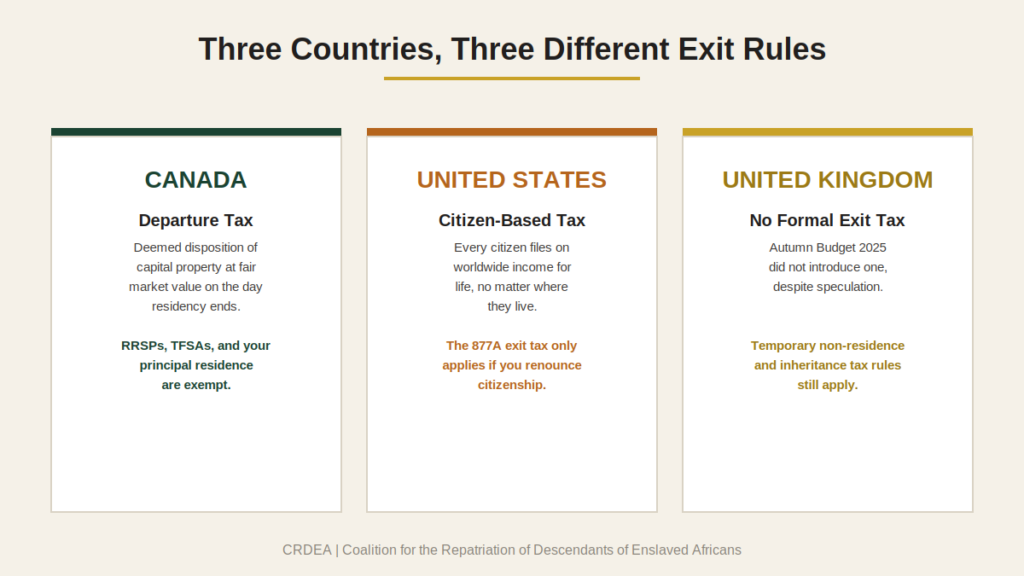
Yes, in effect. Canada does not use the phrase “exit tax” in its own legislation, but the mechanism, commonly called departure tax, works the same way. On the day you cease to be a Canadian tax resident, the Canada Revenue Agency treats you as having sold most of your capital property (non-registered investments, foreign real estate, cryptocurrency) at fair market value, even if you haven’t actually sold anything. Half of any resulting gain is added to your income for that final tax year and taxed at your marginal rate.
Some assets are excluded from this deemed disposition: RRSPs and RRIFs, TFSAs, your principal residence, Canadian real estate (which stays taxable later, on actual sale), and most pension entitlements. You’ll also need to file a final departure tax return, and if you own more than a set threshold in affected property, additional disclosure forms are required.
After you leave, Canada doesn’t fully let go either. Non-residents face a 25 percent withholding tax on Canadian-sourced income such as dividends, interest, rental income, and RRSP withdrawals, though this rate is often reduced under a tax treaty between Canada and your new country of residence. If a large deemed gain would create a cash-flow problem, CRA allows deferral of the departure tax by posting adequate security, worth discussing with a cross-border tax professional before you leave rather than after.
Does the US Tax You After You Move Abroad?
This is the point where most guides conflate two different things, and it matters which one applies to you.
The first is citizenship-based taxation. Every US citizen, wherever they live, must file a US tax return every year on worldwide income for as long as they hold citizenship. Moving to Ghana, Kenya, Nigeria, or Trinidad and Tobago doesn’t end that obligation. The Foreign Earned Income Exclusion and foreign tax credits can reduce or eliminate double taxation in practice, but the filing requirement, along with FBAR and FATCA disclosure for foreign bank accounts, continues indefinitely. This is a permanent compliance cost, not a one-time bill.
The second is the actual exit tax, under Internal Revenue Code Section 877A. This only applies if you formally renounce US citizenship or give up long-term green card status, and even then, only if you meet the threshold for a “covered expatriate”: a net worth of $2 million or more, average annual net tax liability above roughly $211,000 (the 2026 threshold), or failure to certify five years of US tax compliance on Form 8854. If you’re simply relocating while keeping your US passport, the 877A exit tax does not apply to you.
The practical takeaway: a US citizen moving to any of these four countries while keeping citizenship faces ongoing annual filing, not an exit tax. The exit tax only becomes relevant if renouncing citizenship is part of the plan, which is a separate and consequential decision with its own tradeoffs worth discussing with a qualified advisor.
Is There a UK Exit Tax When You Leave the UK?
Unlike Canada, the UK does not impose a formal exit tax on individuals. That said, leaving does carry real costs that function similarly in practice.
Non-residents typically lose the UK’s tax-free personal allowance (£12,570 for 2025/26), unless preserved through specific UK ties or a double tax treaty provision. The UK’s Temporary Non-Residence rules can also catch people out: if you were UK resident in at least four of the seven tax years before leaving and you return within five years, certain income and capital gains realized during your time abroad become taxable in the year you come back. UK capital gains tax also continues to apply to disposals of UK land and property regardless of where you’re living at the time.
There’s also an inheritance tax consideration for anyone who was a long-term UK resident. If you were UK resident for 10 of the previous 20 tax years (the “deemed domicile” threshold under the reformed rules from April 2025), you retain UK inheritance tax exposure on worldwide assets for a tail period after you leave, scaling with how long you were resident. Ahead of the Autumn 2025 Budget, there was extensive speculation about a formal 20 percent “settling-up charge” on unrealised gains for wealthy individuals leaving the UK. That Budget was delivered in November 2025, and the government did not introduce it. The inheritance tax nil-rate band also remains frozen at £325,000, which quietly pulls more estates into scope each year as asset values rise. Anyone with significant UK assets should still confirm their position with HMRC or a cross-border adviser before departure, since the temporary non-residence and inheritance tax rules remain fully in force even without a standalone exit charge.
What Benefits Do Ghana, Kenya, Nigeria, and Trinidad Offer Returning Residents?
The benefit picture is uneven across the four destinations, and the honest version of that story matters more than a flattering one.
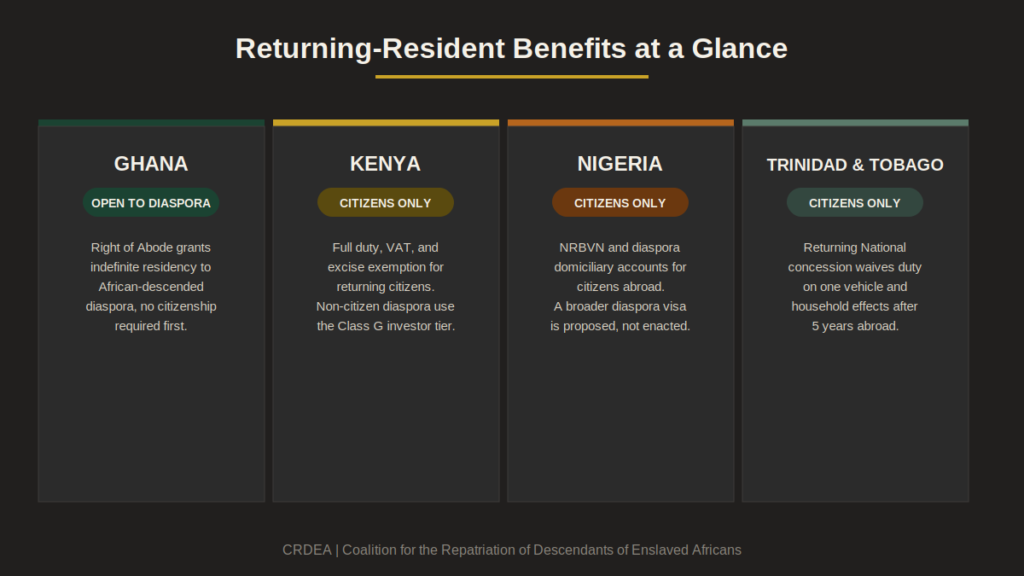
Ghana offers the broadest opening. Its Right of Abode, established under the Immigration Act, grants indefinite residency and work rights to persons of African descent in the diaspora, without requiring citizenship first. A dual citizenship pathway also exists for those who choose to naturalize, which brings a meaningful practical benefit: citizens can hold land in perpetuity, while non-citizens are generally limited to leases of up to 50 years. The program, part of the wider Beyond the Return initiative, went through a brief pause and reform earlier in 2026 aimed at streamlining fees and processing times, with a Homeland Return Bill proposed to further codify the pathway. Applicants should confirm current fees and timelines directly with Ghana’s Ministry of the Interior, since both have been in flux during the reform process.
Kenya tells a different story, one CRDEA has covered directly in Kenya’s diaspora residency gap. Kenyan citizens who move back qualify for a genuinely strong benefit: full exemption from import duty, excise duty, VAT, and the import declaration fee on personal effects, plus a duty-free replacement vehicle under conditions set by the Kenya Revenue Authority. Dual citizenship has also been permitted since the 2010 Constitution. But none of this extends to diaspora members of African descent who aren’t Kenyan citizens. For that group, the main formal route remains the Class G investor permit, pitched at a capital tier well above SME-scale investment, which is precisely the gap CRDEA’s ADSII proposal is designed to close.
Nigeria currently offers strong tools for its own citizens abroad, including the Non-Resident Biometric Verification Number account and diaspora domiciliary accounts that simplify moving money and investment proceeds in and out of the country, with the Nigeria Tax Act 2025 clarifying residency-based tax treatment from 2026 onward. A dedicated visa or passport category for diaspora returnees, including broader framing around African-descended returnees, has been proposed publicly but is not yet enacted policy.
Trinidad and Tobago operates a long-standing Returning National concession under Section 45A of the Customs Act, in place since 1994, waiving customs duty and motor vehicle tax (VAT still applies) on one vehicle and duty on household effects, for citizens, former citizens, or the spouses of citizens who’ve lived abroad continuously for five years or more. A National Diaspora Policy aligned with Vision 2030 has been in development, but as with Kenya and Nigeria, current concessions are tied to citizenship, not to African ancestry alone.
How Do You Plan the Full Cost of Your Move Before You Book a Flight?
Every figure above changes depending on your household size, what you’re shipping, whether you bring a vehicle, and which of the four destinations you’re moving to. That’s the gap the Repatriation Cost Calculator at MetricSuite Tools was built to close.
Enter where you’re moving from (the UK, US, or Canada), where you’re moving to (Jamaica, Nigeria, Kenya, Ghana, or Trinidad and Tobago), and your household details, and it returns a one-time relocation cost, a monthly cost-of-living comparison, and a savings runway showing how long your money lasts once you land. It also flags country-specific rules that trip people up, including what actually happens to a UK pension, a US 401(k), or a Canadian RRSP once you’re a non-resident, and the real vehicle duty position for each destination rather than the generic version repeated in shipping-company guides.
Running your own numbers through it before shipping a container or giving notice on a job is the difference between a repatriation plan and a guess.
Understanding these costs in advance is what turns the Right of Return from an aspiration into an executable plan. CRDEA’s continued policy work, including the ADSII framework, is built on the same premise: that structured, well-planned return benefits both the returnee and the receiving country. It is part of the case for clear residency and economic rights that the diaspora deserves.
The Coalition for the Repatriation of Descendants of Enslaved Africans (CRDEA) advocates for formal immigration pathways and permanent residency for the diaspora returning to the continent. Our objective is to integrate diaspora human capital, investment, and expertise with continental resources to drive sustainable economic empowerment and Pan-African development.
Last Updated
July 26, 2026
REFERENCES
Canada, departure tax
- BDO Global, Canada Departure Tax and Reporting Requirements When You Leave Canada: https://www.bdo.global/en-gb/insights/tax/expatriate-tax/canada-departure-tax-and-reporting-requirements-when-you-leave-canada
- Crowe Soberman LLP, Departure Tax in Canada: https://www.crowe.com/ca/crowesoberman/insights/departure-tax-in-canada
- Grant Thornton (RCGT), Leaving Canada to Work: Avoid Unpleasant Tax Surprises: https://www.rcgt.com/en/insights/expert-advice/leaving-canada-avoid-unpleasant-tax-surprises/
United States, citizenship-based taxation and Section 877A
- The Tax Adviser (AICPA), Bidding Farewell to US Citizenship: Understanding the Exit Tax: https://www.thetaxadviser.com/issues/2024/sep/bidding-farewell-to-us-citizenship-understanding-the-exit-tax/
- PKF O’Connor Davies, The Grass May Not Be Greener for Expatriates Leaving the US for Tax Relief: https://www.pkfod.com/insights/the-grass-may-not-be-greener-for-expatriates-leaving-the-u-s-for-tax-relief/
- 1040 Abroad, Exit Tax Explained: A US Expat’s Guide to Expatriation Tax: https://1040abroad.com/blog/exit-tax-explained-a-us-expats-guide-to-expatriation-tax/
United Kingdom, departure and residence rules
- Global Investments, UK Exit Tax: Wealth Planning After the 2025 Budget (confirms no individual exit tax was introduced): https://www.globalinvestments.net/post/uk-exit-tax-wealth-planning-2025-budget
- Grant Thornton UK, Autumn Budget 2025: Tax Response: https://www.grantthornton.co.uk/insights/autumn-budget-2025/autumn-budget-2025-tax-response/
- BDO UK, Leaving the UK: Breaking Tax Residence: https://www.bdo.co.uk/en-gb/insights/tax/private-client/leaving-the-uk
- Low Incomes Tax Reform Group, Non-Residents and Capital Gains Tax: https://www.litrg.org.uk/savings-property/capital-gains-tax/non-residents-and-capital-gains-tax
Ghana, Right of Abode
- Ministry of the Interior, Republic of Ghana, Right of Abode: https://www.mint.gov.gh/e-services-portal/right-of-abode/
- American Emigration Revue, Ghana Diaspora Citizenship Program Paused, Reformed and Granted: https://americanemigration.com/news/global-affairs/ghana-hits-pause-on-diaspora-citizenship-then-hits-reset/
- Global Voices, The African Countries Offering Citizenship to Diasporans: https://globalvoices.org/2025/08/17/the-african-countries-offering-citizenship-to-diasporans/
Kenya, returning residents and diaspora policy
- Kenya Revenue Authority, Guidelines for Returning Residents: https://www.kra.go.ke/individual/diaspora-affairs/learn-about-kenyans-living-abroad/guidelines-for-returning-residents
- State Department for Diaspora Affairs, Republic of Kenya: https://diaspora.go.ke/
- The Commonwealth, Supporting a National Vision: Kenya’s Diaspora Investment Strategy 2025-2030: https://thecommonwealth.org/news/blog-supporting-national-vision-kenyas-diaspora-investment-strategy-2025-2030
Nigeria, diaspora investment tools and tax reform
- Nairametrics, Tax Strategies for Nigerian Diaspora Investors in 2026: https://nairametrics.com/2026/05/30/tax-strategies-for-nigerian-diaspora-investors-in-2026/
- Nigeria Housing Market, Nigeria’s Diaspora Return Opportunity: From Cultural Roots to Economic Gains: https://www.nigeriahousingmarket.com/news/nigerias-diaspora-return-opportunity-from-cultural-roots-to-economic-gains
Trinidad and Tobago, Returning National concessions
- Customs and Excise Division, Republic of Trinidad and Tobago, Information for Returning Nationals: http://www.customs.gov.tt/travelling/returning-nationals
- Trinidad and Tobago Trade and Business Portal, Returning National: https://info.ttbizlink.gov.tt/investment-incentives/returning-national
Repatriation cost calculator
- MetricSuite Tools, Repatriation Cost Calculator: https://metricsuite.tools/repatriation-calculator/
A note on sourcing: the Ghana fee figures are drawn from press coverage rather than a single government primary source and are framed with hedged language (“in the low thousands”) accordingly, since both application fees and the citizenship pathway itself have been in reform during 2026. The UK exit tax question is settled: the Autumn 2025 Budget was delivered in November 2025 and did not introduce an individual exit charge, confirmed by post-Budget analysis, so the article states this as fact rather than reported speculation.