In March 2026, the United Nations General Assembly adopted what’s now widely being called the UN gravest crime against humanity resolution, the first resolution in the UN’s 80-year history dedicated exclusively to the transatlantic slave trade. Four months later, CARICOM Heads of Government approved a revised Ten-Point Plan for Reparatory Justice, and Emancipation Day 2026 landed in the middle of the 25th anniversary of the Durban Declaration. None of this happened in isolation. This article breaks down what the resolution actually says, what CARICOM changed, how the Durban anniversary ties the two together, and what the moment means in practical terms for the African diaspora.
What Did the UN’s Gravest Crime Against Humanity Resolution Actually Do?
On 25 March 2026, the UN General Assembly adopted the “Declaration of the Trafficking of Enslaved Africans and Racialized Chattel Enslavement of Africans as the Gravest Crime against Humanity,” recorded under UN document A/80/L.48. The vote fell on the International Day of Remembrance of the Victims of Slavery and the Transatlantic Slave Trade, the day the UN has observed annually since 2006.
“Crime against humanity” isn’t just strong language, it’s a specific legal category with roots in the Nuremberg trials and codified today in the Rome Statute of the International Criminal Court. It’s typically reserved for systematic, large-scale atrocities such as genocide, apartheid, and mass enslavement. Placing the transatlantic slave trade inside that category, and naming it the gravest example of it, is the UN General Assembly formally aligning historical slavery with the same legal register used for the 20th century’s worst documented atrocities.
The resolution passed by a wide margin, but it wasn’t unanimous. Here’s how the vote broke down:
- 123 countries in favor, including the majority of Latin America, Africa, the Caribbean, and the Asia-Pacific region
- 3 countries against: the United States, Israel, and Argentina
- 52 abstentions, including the United Kingdom and most European Union member states
- 15 countries absent for the vote
The resolution is not legally binding. UN General Assembly resolutions rarely are. But it carries real political weight, because it resets the baseline language that governments, courts, and future negotiators now have to work from. The text calls on member states to engage in good faith dialogue on reparatory justice, including formal apologies, the return of looted cultural property, financial compensation, and guarantees that the racial hierarchies built by slavery won’t be repeated in policy or practice going forward.
That’s the plain-English version of what happened. The next section covers who pushed it through, and who didn’t.
Why Did Ghana Lead the Push, and Who Opposed It?
Ghana sponsored the resolution and rallied the 55-member African Union bloc behind it. President John Dramani Mahama had signaled the move a year earlier, telling the General Assembly in September 2025 that Ghana would formally push to have the transatlantic slave trade declared the gravest crime against humanity. Ghana’s Foreign Minister, Samuel Okudzeto Ablakwa, framed the vote as a matter of overdue accountability rather than symbolism.
The specific language matters more than it might look. At the 2001 Durban conference, negotiators could only agree that the slave trade “should have been” considered a crime against humanity, a phrasing that stopped short of an outright declaration and prompted several Western delegations to walk out rather than accept even that. In 2026, the UN moved from conditional language to a direct statement: it is the gravest crime against humanity. This time, the same bloc of states stayed in the room. They voted no or abstained, but they didn’t block the process.
The United States, Israel, and Argentina voted against the resolution. The United Kingdom, along with most EU member states, abstained. None of these governments issued a joint statement disputing the historical facts underlying the resolution. Where objections were stated publicly, they centered on concerns about legal exposure and precedent, not a dispute over the history itself.
Even UN Secretary-General António Guterres, addressing the Assembly ahead of the vote, said far bolder action was still required from a broader set of member states to confront historical injustice. That’s a reminder that even among the 123 governments that voted yes, the resolution is being treated as a floor, not a finish line.
What Is CARICOM’s Revised Ten-Point Plan for Reparatory Justice?
CARICOM’s reparations framework didn’t start in 2026. The original Ten-Point Plan for Reparatory Justice was adopted by CARICOM Heads of Government in July 2014, developed by the CARICOM Reparations Commission (CRC) under the leadership of Professor Sir Hilary Beckles. It was last updated in 2018. The plan lays out specific claims directed at former colonial powers, covering areas like a full formal apology, debt cancellation, and investment in public health and cultural institutions tied to slavery’s lasting effects.
In February 2026, at the 50th Regular Meeting of CARICOM Heads of Government in St. Kitts and Nevis, leaders tasked a Prime Ministerial Subcommittee on Reparations with reviewing the plan ahead of the November 2026 Commonwealth Heads of Government Meeting in Antigua and Barbuda. By July 2026, at the 51st Regular Meeting in Gros Islet, Saint Lucia, Heads of Government approved the revised document, retitled the “Revised CARICOM Ten Point Plan for Reparatory Justice: A Manifesto for the Coming Enlightenment.”
The revision does two things the original plan didn’t do as explicitly. It positions reparations as a global human rights imperative rather than a bilateral grievance between the Caribbean and specific former colonial powers, and it puts new emphasis on the disproportionate impact of slavery and colonialism on women and girls.
The revised plan didn’t emerge in a vacuum. In June 2026, Ghana hosted the High-Level Consultative Conference on Reparations in Accra, bringing together governments, legal scholars, international organizations, and civil society leaders to work toward a unified African and diaspora reparations framework. CARICOM’s July revision followed directly on the heels of that gathering, which is part of why Ghana’s UN push and CARICOM’s regional plan are increasingly treated as one coordinated effort rather than two separate initiatives.
CARICOM paired the plan’s approval with a set of follow-up commitments:
- Deeper coordination with the African Union on a shared reparations strategy
- A CARICOM delegation presence at the November 2026 Commonwealth Heads of Government Meeting
- A Third Regional Conference on Reparations, to be held in Barbados
- The unveiling of the Newton Slave Burial Ground Memorial in Barbados
In July 2026, CRC leadership traveled to the United Kingdom to present the revised manifesto directly to British parliamentarians, part of what CRC Chair Sir Hilary Beckles described publicly as a shift from seeking acknowledgment to entering negotiation. Whatever position individual governments ultimately take on the specific terms, that shift in posture, from commemorative statement to negotiating document, is itself the headline.
How Does the Durban Declaration’s 25th Anniversary Fit Into This?
The Durban Declaration and Programme of Action came out of the 2001 World Conference Against Racism, Racial Discrimination, Xenophobia and Related Intolerance, held in Durban, South Africa. A quarter century later, it remains the most comprehensive international framework addressing the ongoing legacies of slavery, colonialism, and systemic racism.
2026 marks the Declaration’s 25th anniversary, and the timing overlapped directly with the rest of this year’s developments. The UN Human Rights Council held a high-level panel on the anniversary in February 2026. On August 1, 2026, Emancipation Day, the CARICOM Reparations Commission issued a message explicitly tying the UN resolution to the Durban anniversary, calling on governments to fully implement the Durban framework and resist efforts to weaken it.
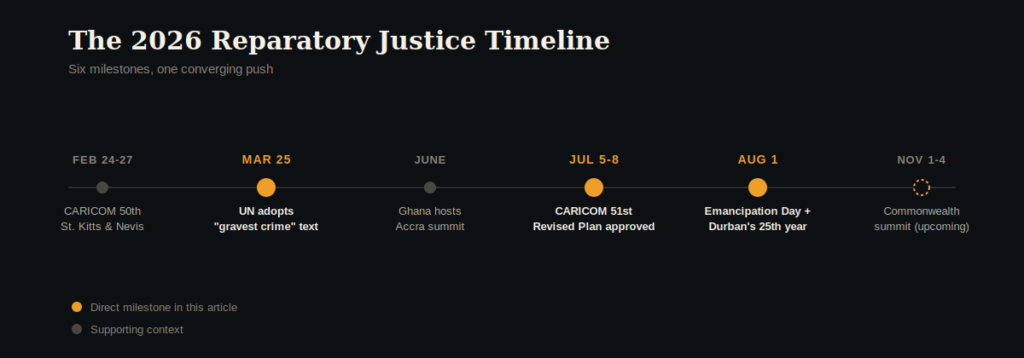
Taken individually, a UN resolution, a regional reparations plan, and an anniversary observance could each be written off as symbolic. Taken together, over roughly five months of the same calendar year, they read differently. This is a pattern of institutions, the UN, the African Union, CARICOM, and the UN Human Rights Council, converging on the same language and the same historical framing at close to the same time. That convergence is what makes 2026 a materially different moment than prior anniversaries and prior resolutions on this subject.
What Does This Actually Change for the Diaspora Right Now?
It’s worth being direct about what this moment does and doesn’t do. The UN resolution isn’t legally binding, and CARICOM’s plan isn’t a treaty. No government is required by either document to pay anything, return anything, or change any law on a set timeline. Anyone telling you this settles the reparations question by itself is overstating it.
What it does do is change the negotiating floor. Governments now have to respond to a UN text that uses the word “is,” not “should have been.” Diplomats, courts, and future negotiators will reference A/80/L.48 the way earlier generations referenced the Durban text: as the baseline everyone has to engage with, whether they agree with it or not. CARICOM’s revised plan does the same work regionally, handing negotiators a sharper, more current document to bring to forums like November’s Commonwealth summit.
For individual members of the diaspora, the practical value of this moment is less about waiting for a check and more about using the language while it’s live. Institutional recognition creates an opening for the specific, structural asks that actually move money and policy, things like investor permit reform, cultural property return, and education curriculum change, to get a hearing they didn’t have a year ago. That’s the gap between a resolution and a result, and it’s where organized advocacy does its work.
For context on where things currently stand: of the major Western European nations connected to the transatlantic trade, the Netherlands remains the only one to have issued a formal, unambiguous national apology for its role in slavery. That gap between institutional recognition at the UN level and individual national accountability is exactly the space these documents are designed to close over time, not overnight.
What Is CRDEA Doing With This Momentum?
CRDEA’s position has never depended on any single resolution passing. Our policy work, particularly the ADSII and DRIF frameworks, focuses on a specific structural barrier: the investor permit thresholds that currently divert diaspora capital away from Africa and toward regions with far lower entry costs. That barrier exists whether or not the UN has weighed in on it.
What changes with the UN resolution and CARICOM’s revised plan is the argument’s footing. A government that has just voted to call the transatlantic slave trade the gravest crime against humanity, or approved a manifesto framing reparations as a global human rights imperative, has a harder time defending a $100,000-plus investor threshold that keeps descendants of that same trade out of the market. That’s the gap CRDEA’s proposals are built to close.
There are three concrete ways to use this moment instead of just watching it pass:
- Read CRDEA’s ADSII policy framework so you understand the specific reforms we’re proposing to governments, and where you can add your voice
- Share this piece with anyone in your network working in policy, law, or diaspora organizing, since most people are seeing the UN vote and CARICOM’s plan as separate stories rather than one coordinated push
- If your government has taken a position on the resolution or CARICOM’s plan, tell them you’re watching how they follow through
Check back as we track how CARICOM and Ghana’s coordination develops ahead of November’s Commonwealth summit.
Last updated: August 11, 2026
Sources
- UN News: https://news.un.org/en/story/2026/03/1167199
- CARICOM.org (Ten-Point Plan): https://caricom.org/caricom-leaders-strengthen-reparations-agenda/
- African Union statement on A/80/L.48: https://au.int/sw/node/46184
