A return to Africa and the Caribbean is a capital allocation decision before it is anything else. Most diaspora returnees price the flight and the shipping container, then stop. The costs that break a budget arrive later: a vehicle duty rule, a taxed retirement account, a three-month gap between landing and income.
This guide gives you a phased framework for a return to Africa and the Caribbean, the failure points that sink returnees, and the specific tools that test each decision with numbers before you commit money. It is built for people planning a diaspora repatriation plan, a bi-continental lifestyle strategy, or Pan-African business investment at SME scale in Africa or the Caribbean.
Why a Return to Africa and the Caribbean Fails on Arithmetic, Not Intent
Intent is rarely the problem in a return to Africa and the Caribbean. Diaspora capital is already moving. Kenya’s diaspora remittances reached a record USD 4.95 billion in 2024, per statements by President Ruto reported by AllAfrica. The IDB estimates the Caribbean received about US$20.9 billion in remittances in 2025, with Jamaica alone taking a record US$3.49 billion, roughly 15% of GDP, as summarized by MetricSuite.
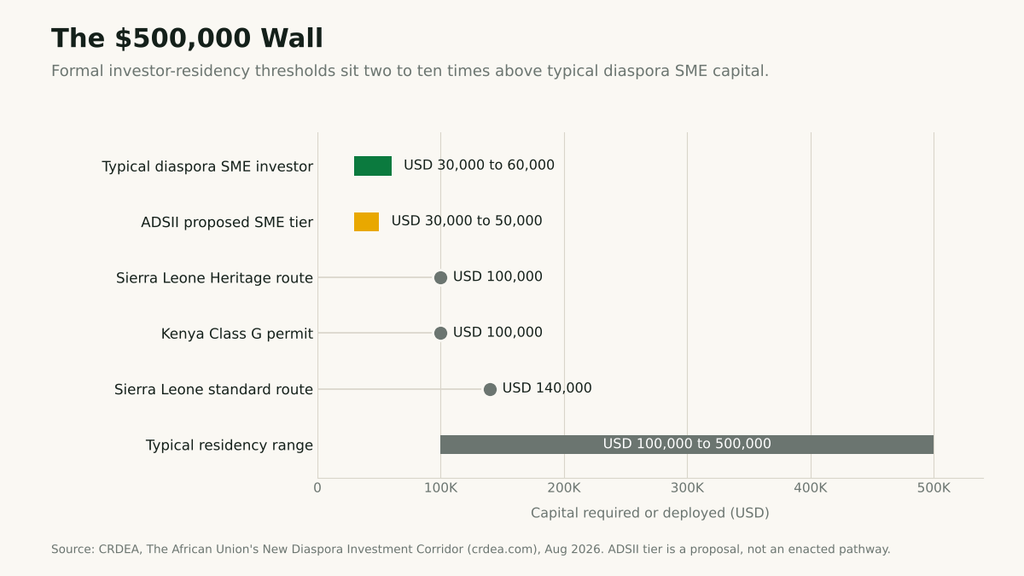
That money moves as household transfers. It rarely converts into structured investment or residency, and the reason is mostly structural. CRDEA documents what it calls the $500,000 Wall: formal investor-residency thresholds across the continent typically sit between USD 100,000 and USD 500,000, while the typical diaspora SME investor deploys USD 30,000 to 60,000. Sierra Leone’s Heritage Naturalization route, built for applicants of African descent, still requires USD 100,000. Kenya’s Class G investor permit sits at the same figure.
Three market realities shape every plan:
- Entry thresholds are set for large capital. If your plan depends on an investor residency category, check the threshold first. Many SME-scale returnees will not qualify, and the policy work to create an SME tier (CRDEA’s ADSII proposal asks for USD 30,000 to 50,000) is still pending.
- Trade frameworks are signed, not fully executed. Nearly all 55 African Union states have joined the African Continental Free Trade Area, but implementation is uneven. In the Caribbean, CSME duty-free status depends on the specific tariff line. Treat both as upside to verify, not as a base case.
- Rules change. Duty schedules, residency clocks, and withholding rates all move. A shipping-company blog from three years ago is not a source.
If a plan for a return to Africa and the Caribbean survives these three facts, it is worth building. If it only works under optimistic assumptions about all three, it is a lifestyle wish, not a plan.
The Four-Phase Framework for a Return to Africa and the Caribbean
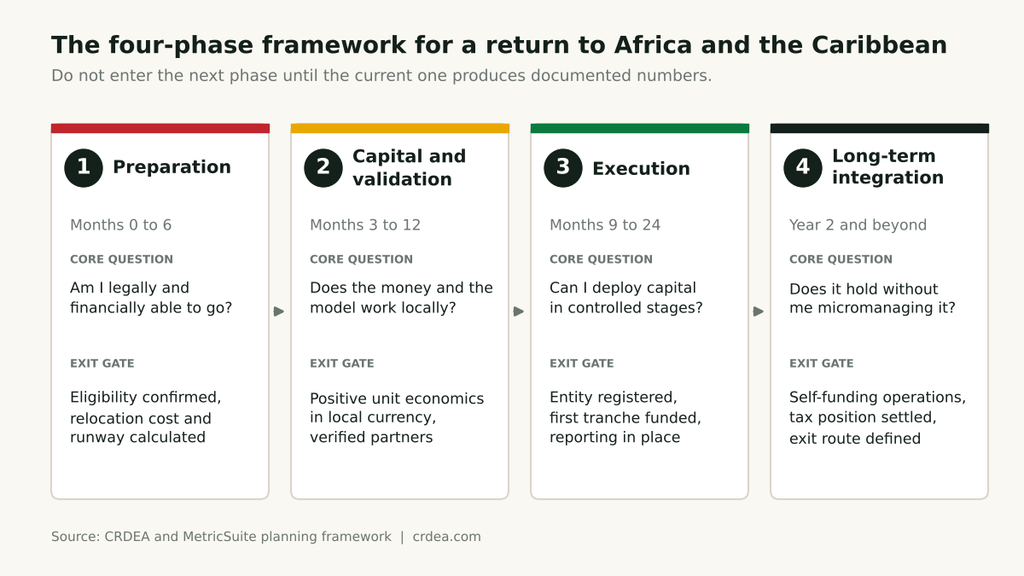
Run your return to Africa and the Caribbean as four gated phases. Do not enter the next phase until the current one produces documented numbers.
| Phase | Core question | Exit gate |
|---|---|---|
| 1. Preparation | Am I legally and financially able to go? | Eligibility confirmed, relocation cost and runway calculated |
| 2. Capital and business validation | Does the money and the business model work locally? | Positive unit economics in local currency, verified partners |
| 3. Execution | Can I deploy capital in controlled stages? | Entity registered, first stage funded, reporting in place |
| 4. Long-term integration | Does the structure hold without me micromanaging it? | Self-funding operations, tax position settled, exit options defined |
Phase 1: Preparation (Months 0 to 6)
The goal is to establish what you are legally allowed to do and what your return to Africa and the Caribbean will cost.
Confirm returning-resident eligibility before anything ships. Concessions on a return to Africa and the Caribbean are not automatic. Most destinations require a minimum period abroad: three consecutive years for Jamaica, twelve months for Ghana, nine months for Nigeria, per CRDEA’s analysis of repatriation costs. Run your dates through the Returning Resident Eligibility Checker, which covers Jamaica and Ghana, and read the Returning Resident Customs Rules guide for the four-country comparison. Then confirm with the destination customs authority in writing.
Check access before choosing a country. If you hold a Caribbean passport and are considering an African destination, the Caribbean Visa Access Checker shows where entry is visa-free and on what terms. Visa-free entry is not residency. It is the first filter only.
Price the full return to Africa and the Caribbean. Use the Repatriation Cost Calculator to model one-time relocation cost, the monthly cost-of-living shift, and your savings runway. It covers moves from the UK, US, or Canada to Jamaica, Nigeria, Kenya, Ghana, or Trinidad and Tobago. The runway output is the number that matters most: how many months your savings cover the gap between destination costs and income you retain.
Map what happens to your retirement accounts. This is the line item most people discover too late. Per CRDEA’s sourced summary, a US 401(k) or IRA stays taxable by the IRS wherever you live, and early withdrawal before 59 and a half adds a 10% penalty. A Canadian RRSP faces 25% non-resident withholding, reduced to 15% in some cases if converted to a RRIF first. A UK pension generally stays in the UK and is drawn down remotely. Get a cross-border tax adviser to confirm your specific position before you move any account.
Decide the vehicle question early in any return to Africa and the Caribbean. Jamaica currently offers no duty exemption on vehicles for returning residents. Kenya exempts one replacement vehicle under strict conditions. Trinidad and Tobago waives customs duty and motor vehicle tax but still charges VAT. The gap is a five-figure swing on the same car. Model it with the Kenya Vehicle Import Duty Calculator or the Jamaica Import Duty Calculator before deciding to ship.
Phase 2: Capital and Business Validation (Months 3 to 12)
Phase 2 tests whether the capital and the business model behind your return to Africa and the Caribbean survive contact with local costs. Do this from abroad, while you still have income.
Compare destinations on cost, not feeling. The Business Destination Comparator lines up African markets on setup cost and operating conditions. Pair it with the African Business Registration Cost Estimator or the Caribbean Business Registration Cost Estimator so you know registration costs before an agent quotes you.
Validate unit economics in local currency. If your plan is agricultural, benchmark it before you send money. The Crop Profit Calculator gives input costs, yield, and gross profit per hectare, and the Livestock Profitability Calculator does the same per head. Their main use is as an independent check on what a farm manager or partner reports to you. For any business, run the Break-Even Calculator and use the Business Destination Comparator results to set a realistic volume target.
Cost the labour properly. Payroll is more than wages. Use the African Employee True Cost Calculator or the Caribbean Employee True Cost Calculator to include statutory contributions and employer levies. If you plan to take a salaried role instead, the African PAYE Calculator and Caribbean PAYE Calculator show take-home pay after local tax.
Verify land and assets independently. If land is part of the plan, use the Ghana Land Purchase Cost Calculator to see stamp duty, legal, search, and registration costs. Verify tenure through an independent lawyer and the relevant land registry. Never rely on a seller’s or intermediary’s documents alone. CRDEA’s ADSII framework itself requires independent asset valuation and verification of land tenure, which is a sound standard for private buyers as well.
Gate: you have a return to Africa and the Caribbean business case that is profitable in local currency, with the cost of power, labour, registration, and logistics included, and with a partner or operator you have checked independently.
Phase 3: Execution (Months 9 to 24)
Deploy capital for your return to Africa and the Caribbean in stages tied to evidence, not in a single transfer.
- Stage the money. Release tranches against milestones: entity registered, land secured with clean title, equipment delivered, first revenue. Hold a reserve outside the project.
- Register properly. Operate through a registered local entity. CRDEA’s framework assumes a registered Kenyan company, documented partnerships, and tax compliance. Treat that as the baseline for any investor, whether or not a residency category depends on it.
- Set up reporting. Track income, expenses, and currency in one place. The Small Business Bookkeeping Workbook is built for income, expenses and monthly totals in one Excel file, and the Free Invoice Generator covers billing.
- Budget for power. Run the Generator vs Grid Power Cost Calculator for any site where outages are likely. Backup power is an operating cost, not an exception.
Phase 4: Long-Term Integration (Year 2 and Beyond)
Integration in a return to Africa and the Caribbean means the structure works without constant intervention and your tax and residency position is stable.
- Confirm what residency status you actually hold and what renewal conditions apply.
- Settle your tax residency position in both countries with a qualified adviser.
- Define an exit path: how you would sell, transfer, or wind down the operation if you needed to.
- Review quarterly against the numbers from Phase 2. If actuals diverge by more than your buffer, adjust before adding capital.
The Traps That Break a Return to Africa and the Caribbean
These are the recurring failure points in a return to Africa and the Caribbean. Each has a specific countermeasure.
Trap 1: Underestimating Operating Costs and Bureaucratic Friction
Friction is not a moral failing of any country. It is the normal operating condition of markets still building formal institutions, and it has a cost. Approvals take longer. Power is less reliable. Some processes depend on relationships as much as procedure.
Countermeasure: price friction into your return to Africa and the Caribbean plan. Add time to every approval. Budget for backup power. Build a six to twelve month cash buffer beyond the calculator runway. Hire a local lawyer and accountant before you buy anything, and pay them to find problems, not to confirm your plan. For customs, confirm every figure with the revenue authority, because clearing agents add charges no calculator can see in advance.
Trap 2: Importing a Western Business Model Unchanged
A model that works in Toronto, London, or Atlanta assumes reliable power, formal credit, card payments, and predictable permitting. Many markets in a return to Africa and the Caribbean run on cash, mobile money, informal credit, and relationships.
MetricSuite’s analysis of diaspora entrepreneurship makes the useful point: the businesses that work solve one specific, expensive, everyday problem, and they are built for the market as it exists. M-KOPA’s pay-as-you-go asset financing in Kenya and mobile payment tools for Ghanaian smallholders are examples of fitting a model to local rails rather than importing one.
Countermeasure: before building, check how customers actually pay and what it costs. The Mobile Money Fees tool shows what M-Pesa, MTN MoMo, and Airtel Money charge once money lands. Talk to operators currently running businesses in your target market, not only people who left it.
Trap 3: Mismanaging Capital Flow, Currency Risk, and Cross-Border Tax
Three separate leaks sit in this trap, and each one erodes a return to Africa and the Caribbean funded from abroad.
Transfer cost. The fee is only part of it. The exchange-rate margin and the cash-out fee usually cost more. Compare corridors with the Africa Remittance Comparison or the Caribbean Remittance Comparator before every large transfer, and see the spread you are being charged against the Currency Converter.
Currency depreciation. If you earn or hold capital in USD, CAD, or GBP and spend in a local currency, a weak currency helps your purchasing power. If you import inputs, it hurts. The Cedi Depreciation Buffer Calculator shows how to price imports to survive a weaker cedi, and the same logic applies to any import-dependent business. Price in a currency buffer, and avoid holding all working capital in one currency.
Cross-border tax. US citizens remain taxable by the IRS regardless of residence. Retirement withdrawals trigger the penalties and withholding described above. Treat the tax position as a design input, not an afterthought, and get written advice from someone who works in both jurisdictions.
Family support is also a capital flow. If you send money to relatives, put a number on it. The Black Tax Calculator gives you the annual figure and its effect on your own savings position. An unbudgeted obligation is one of the most common ways a runway shortens.
Trap 4: The Lifestyle Trap (Emotional Bias Over Feasibility)
The return is often driven by legitimate frustration with stalled careers, rising rent, and a sense of ceiling in the West. That frustration is useful as information about where there are unmet needs. It is a poor basis for a go or no-go decision on a return to Africa and the Caribbean.
The lifestyle trap shows up as: choosing a destination by sentiment instead of cost; skipping a scouting visit; accepting a partner because of shared identity rather than verified track record; and treating a low cost of living as proof the business will be profitable.
Countermeasure: write down the conditions under which you will not go, before you are emotionally committed. Examples: runway under 12 months after all costs; no verified title on the land; no operator with a checkable record; projected break-even beyond 24 months. If a condition triggers, you stop. Set the rules while you are still objective.
Building a Bi-Continental Lifestyle Strategy
Not every return to Africa and the Caribbean needs to be permanent. Diaspora policy conversations in 2026 have shifted toward circulation, where skills, networks, and capital move back toward the continent without requiring full physical relocation. The African Union’s proposed “Coming Home to Invest” corridor, discussed at a July 2026 dialogue, is framed as a coordination framework connecting diaspora investors with governments, institutions, and vetted projects. It does not replace national residency rules.
A bi-continental lifestyle strategy for a return to Africa and the Caribbean keeps income and legal status in one jurisdiction while building assets and operations in another. It reduces the risk of a single point of failure and keeps your runway intact. The practical version:
- Keep a stable income base in the origin country while the destination business proves itself.
- Use the cost calculators in reverse. Run the Repatriation Cost Calculator with retained income entered, so the result shows surplus or shortfall.
- Set a review date. At 12 and 24 months, compare actuals to plan and decide whether to deepen the move, hold, or exit.
- Check trade corridors. If your business exports, the AfCFTA Tariff Lookup and the Africa Export Readiness Checker test whether continental trade preferences apply to your goods. For Caribbean goods, the CSME Tariff Lookup checks CARICOM duty-free status.
Repatriation Financial Planning: A Decision Checklist
Use this before committing capital to a return to Africa and the Caribbean.
- Eligibility: returning-resident status and visa terms confirmed in writing with the destination authority.
- Relocation cost: one-time cost modeled, vehicle decision made, retirement account treatment confirmed with a tax adviser.
- Runway: at least the calculator figure plus a 6 to 12 month buffer, held in accessible funds.
- Unit economics: profitable in local currency with power, labour, registration, and logistics included.
- Currency plan: import exposure identified, buffer priced, transfer corridor compared.
- Legal structure: registered local entity, documented partnership, independently verified land and assets.
- Reporting: bookkeeping and invoicing in place before the first tranche is released.
- Exit conditions: written list of triggers that stop the project, and a defined exit route.
If any line is blank, your return to Africa and the Caribbean plan is incomplete.
Frequently Asked Questions
How much money do I need to return to Africa and the Caribbean?
The cost of a return to Africa and the Caribbean depends on destination, household size, shipping method, and whether you bring a vehicle. A single average is not useful. Use the Repatriation Cost Calculator for your specific move, then add a buffer for the costs no calculator sees.
Do I need to have lived abroad for a set period to qualify for returning-resident benefits?
For a return to Africa and the Caribbean, usually yes, and it varies by country. Jamaica requires three consecutive years, Ghana twelve months, and Nigeria nine months. Trinidad and Tobago and Kenya have their own residency and documentation rules. Confirm with the destination’s customs authority before shipping.
Can small investors get residency through investment?
Most formal investor categories for Pan-African business investment start at USD 100,000 or higher, which excludes many SME-scale investors. CRDEA’s ADSII proposes a USD 30,000 to 50,000 SME tier with asset-based recognition and performance metrics. It is a proposal, not an established pathway, so plan around the rules that exist today.
Is a return to Africa and the Caribbean permanent?
It does not have to be. A bi-continental structure, with income and status in one place and operations in another, is a legitimate strategy and lowers risk during the first two years.
What is the biggest mistake returnees make?
The biggest error in a return to Africa and the Caribbean is assuming the market they left years ago is the market that exists today, and committing capital before testing the numbers. Verify current conditions through local business press and operators in-market.
Next Step
Start your return to Africa and the Caribbean with the numbers. Run your household through the Repatriation Cost Calculator, then work through the full Diaspora Tools hub for remittance, duty, land, farm, and payroll checks. For the policy side of diaspora return, read CRDEA’s work on the African Diaspora SME Investment Initiative.
This guide to a return to Africa and the Caribbean is for planning purposes and is not legal, tax, or financial advice. Duty rates, residency rules, and withholding rates change. Confirm figures with the relevant authority and a qualified adviser before committing money.
Sources
- CRDEA: The Real Cost of Coming Home
- CRDEA: The African Union’s New Diaspora Investment Corridor
- CRDEA: African Diaspora SME Investment Initiative
- MetricSuite: Diaspora Tools hub
- MetricSuite: Repatriation Cost Calculator
- MetricSuite: Diaspora Entrepreneurship in Africa
- MetricSuite: Caribbean Diaspora Investing 2026
- AllAfrica: Kenya diaspora remittances in 2024
- Jamaica Customs Agency: Returning Residents
- Kenya Revenue Authority: Guidelines for Returning Residents
- Ghana Revenue Authority: Passengers’ Obligations at Customs
- Trinidad and Tobago Customs and Excise: Returning Nationals
