
When Economics Wears the Face of Hostility: Understanding the Structural Factors Behind Resistance to African-Owned Businesses in South Africa
By the CRDEA Editorial Desk | Coalition for the Repatriation of Descendants of Enslaved Africans
The South African story is, at its deepest register, a story about land, labour, and longing. It is a story shaped by more than three centuries of colonial extraction, four decades of juridically enforced apartheid, and a post-liberation transition that — for all its moral grandeur — left the architecture of economic inequality largely intact. Against this backdrop, the hostility that has periodically erupted against African-owned businesses and entrepreneurs from other parts of the continent is not a mystery to be sensationalised. It is a wound to be understood — structurally, historically, and with the scholarly patience that complex human realities demand. This essay does not seek to assign blame. It seeks, instead, to illuminate cause, to honour the dignity of all people involved, and to suggest that Pan-African cooperation — not separation — is the most credible path toward shared flourishing.
The Weight of Inherited Inequality
Any honest conversation about economic tension in South Africa must begin with a reckoning with numbers. South Africa consistently ranks among the most unequal societies on earth, with a Gini coefficient that has hovered between 0.63 and 0.67 since the early 2000s — making it one of the highest recorded anywhere in the world (World Bank, 2022). Unemployment, by the expanded definition that includes discouraged work-seekers, exceeded 42 percent of the working-age population as recently as 2023. These are not abstract statistics. They represent tens of millions of human beings whose daily economic experience is defined by precarity, whose aspirations remain structurally constrained not by personal failure but by inherited disadvantage.
When structural scarcity of this magnitude persists across generations, competition for economic space becomes intensely felt. The informal economy — street trading, spaza shops, mobile vending, small-scale services — represents one of the few zones of economic agency accessible to those locked out of formal employment. It is precisely in this zone that the presence of entrepreneurially mobile migrants from elsewhere on the continent is most visible, and most likely to be experienced as competition rather than complementarity. The hostility, then, is not fundamentally about nationality or ethnicity. It is about what economists call labour market displacement anxiety operating in a context of extreme structural scarcity, where the state has not provided adequate buffers, retraining pathways, or economic inclusion frameworks for its most vulnerable citizens.
Afrophobia Is Not Xenophobia: A Critical Distinction
Scholars of migration and political economy have been careful to distinguish what occurs in South Africa from generic xenophobia — the indiscriminate fear of all foreigners. What South Africa has experienced episodically, most violently in 2008, 2015, and 2021, is better described as Afrophobia: a specifically directed hostility toward black African migrants and their commercial enterprises, while European and Asian foreign nationals operating in the same economy face little of the same social pressure (Crush & Ramachandran, 2010). This distinction matters enormously for both diagnosis and remedy.
Afrophobia operates within a peculiar ideological contradiction: the post-apartheid state was built on the moral architecture of Pan-African solidarity — on the generosity of Tanzania, Zambia, Zimbabwe, and other liberation-era hosts who sheltered ANC cadres during the long struggle years. The contradiction between that foundational solidarity and contemporary hostility toward African migrants is not lost on African scholars and activists. What it reveals is that solidarity, when not reinforced by economic structure, policy architecture, and civic education, does not automatically transfer from the political realm into the economic one. Goodwill requires institutional scaffolding.
The Policy Gaps That Create Fertile Ground for Tension
Understanding the structural causes of Afrophobia requires examining not only what governments have done, but what they have not done. Several interrelated policy gaps are worth naming with care.
First, the absence of a functioning regional free movement framework within SADC (the Southern African Development Community) means that African entrepreneurs from Mozambique, Zimbabwe, Malawi, or Nigeria who establish businesses in South Africa do so under conditions of legal precarity — often without secure documentation, formal business registration, or access to the financial protections that come with regulated commercial status. This informal status makes them simultaneously more entrepreneurially agile and more socially vulnerable, operating in the cracks of a regulatory architecture not designed to accommodate them. Entrepreneurs planning to operate across African markets can use tools like the Import Duty Calculator at metricsuite.tools to understand the fiscal landscape they are navigating — but what they cannot calculate away is the absence of a legitimate legal pathway.
Second, the slow pace of post-apartheid redistribution has meant that the majority of South Africa’s indigenous Black population has not experienced the material transformation that liberation promised. When a Nigerian-owned spaza shop thrives while a South African township resident struggles to access capital, the optics — however structurally misleading — are politically potent. The grievance is real even when its target is misidentified. Addressing that grievance requires redistributive policy with teeth: accessible business credit, state procurement preferences for historically disadvantaged South Africans, and social infrastructure investment in townships. None of that is achieved by displacing African migrants.
Third, narrative vacuums are filled with dangerous stories. In the absence of a coherent civic education framework about migration, Pan-African history, and economic interdependence, political entrepreneurs — at both the grassroots and elite levels — have at times found it advantageous to redirect popular frustration toward visible foreign targets. This is not unique to South Africa; it is a pattern with deep historical precedent across every continent. The remedy is not silence but better narrative: evidence-based, humanising, and strategically communicated.
A Vignette From the Ground
Consider the experience of a Zimbabwean woman entrepreneur — let us call her Tendai — who established a small textile and tailoring business in Johannesburg’s inner city in the mid-2010s, employing four local workers and sourcing fabric from both South African and regional suppliers. Her business created employment, circulated money locally, and served a clientele that South African competitors had not found commercially viable to serve. During a period of social unrest, her shop was looted and her equipment destroyed — not by economic competitors, but by young men whose own economic frustration had been channelled into physical displacement. Tendai rebuilt, twice. Her story is representative of thousands: African entrepreneurs whose contribution to local economies is empirically documented yet politically unprotected. Their resilience is a testament not only to individual character but to the Pan-African entrepreneurial tradition that deserves formal recognition and structural protection.
A Constructive Policy Pathway
The path forward is not paved with condemnation. It is paved with architecture — institutional, legal, and communicative. Several converging policy levers merit serious attention from governments, civil society, and diaspora organisations alike.
The African Union’s Agenda 2063 explicitly calls for a continental free movement protocol and the removal of barriers to intra-African trade and investment (African Union, 2015). South Africa’s meaningful engagement with this framework — not merely as a signatory but as an active implementer — would provide legal clarity for African entrepreneurs currently operating in informal grey zones, reducing both their vulnerability and the social friction their informality can generate. For diaspora communities preparing to invest on the continent, understanding the regulatory and tax environment across jurisdictions is essential; the business calculators available at metricsuite.tools offer practical starting points for modelling cross-border commercial viability.
Beyond regional frameworks, South Africa’s township economies would benefit significantly from a dedicated African Diaspora Enterprise Partnership programme — one that pairs incoming African entrepreneurs with local South African partners, mandates knowledge transfer, creates shared ownership structures, and generates employment that is visibly and meaningfully shared. This is not charity. It is intelligent economic design. Research on immigrant entrepreneurship consistently shows that migrant-founded businesses, when formally integrated into local economic ecosystems, generate net employment gains for host communities (Landau & Freemantle, 2010). The question is not whether African entrepreneurs belong in South Africa’s economy — they manifestly do. The question is how their participation is structured so that it is experienced as addition rather than subtraction.
Civil society and diaspora advocacy organisations, including coalitions working on Right of Return and diaspora engagement frameworks, have a specific role to play in producing and distributing the counter-narrative: one that frames African continental mobility as historical normalcy, economic asset, and Pan-African imperative, rather than as threat.
Toward a Continent That Holds All Its Children
The hostility that some African entrepreneurs have encountered in South Africa is a symptom, not a cause. The causes are structural, historical, and ultimately — we must say this with both honesty and hope — correctable. They are correctable because they are human-made. Apartheid was human-made; so was the economic inequality it produced; and so, too, are the policy choices that have allowed that inequality to fester. None of this is destiny.
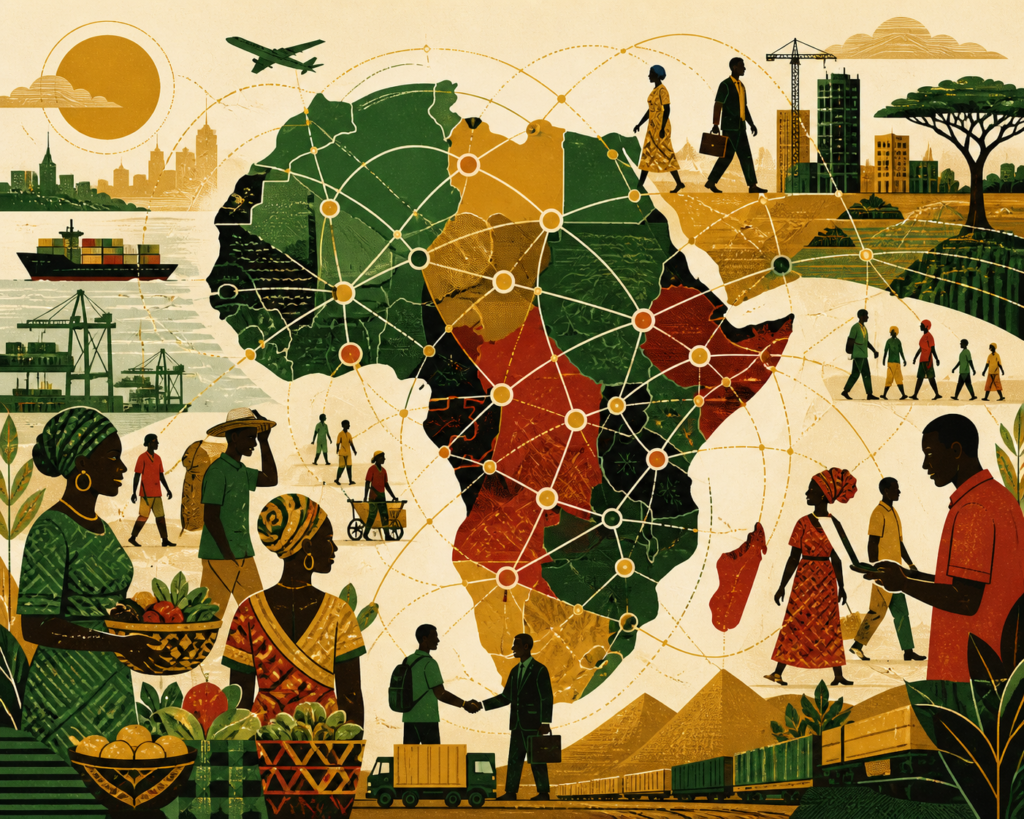
What Pan-Africanism has always offered, at its most intellectually serious, is a framework for thinking about African peoples — on the continent and in the diaspora — as members of a single civilisational project with shared interests, shared heritage, and shared futures. The diaspora’s Right of Return is not merely a sentimental claim. It is an economic proposition: that the skills, capital, entrepreneurial energy, and institutional knowledge accumulated by African descendants across the world represent a resource that the continent needs, and that the continent’s rising markets, cultural vitality, and demographic momentum represent an opportunity that the diaspora should not permanently forgo. Those two realities are not in tension. They are in conversation.

South Africa — the nation that gave the world Ubuntu, that housed the liberation movements of a continent, that produced in Nelson Mandela a figure of global moral authority — is more than capable of being also the nation that leads on creating the institutional architecture for dignified, productive African continental mobility. That work is difficult. It requires political will, civic courage, and a willingness to hold complexity without collapsing it into scapegoating. But it is work that is both necessary and possible.
→ Share this post with a policymaker, an academic colleague, or a fellow diaspora community member who is thinking seriously about the future of Pan-African economic cooperation. Every informed voice added to this conversation moves us closer to the structural solutions that all of us — on both sides of the Atlantic and across the continent — deserve.
References
Crush, J., & Ramachandran, S. (2010). Xenophobia, international migration and development. Journal of Human Development and Capabilities, 11(2), 209–228.
Landau, L. B., & Freemantle, I. (2010). Tactical cosmopolitanism and idioms of belonging: Insertion and self-exclusion in Johannesburg. Journal of Ethnic and Migration Studies, 36(3), 375–390.
World Bank. (2022). South Africa Overview: Development News, Research, Data. The World Bank Group. https://www.worldbank.org/en/country/southafrica/overview
The Coalition for the Repatriation of Descendants of Enslaved Africans (CRDEA) advocates for voluntary, dignified, and legally supported pathways for diaspora return, investment, and partnership with African nations and communities. Learn more at crdea.com.