The $500K Quote vs. the Pan-African Dream
The African Union’s Agenda 2063 formally recognizes the African Diaspora as the continent’s “6th Region” — an estimated 140 million people of African descent living outside the continent, many of whom carry capital, credentials, and a documented intent to invest in their ancestral homelands. The political framing is deliberate and aspirational: the Diaspora is positioned not as a donor class, but as a stakeholder constituency central to Africa’s economic transformation.
The policy documents say one thing. The investment promotion agencies say something else entirely.
In a documented interaction between a Diaspora professional — a hospitality and operations manager with over two decades of international brand experience and a certified Six Sigma Green Belt — and the Botswana Investment and Trade Centre (BITC), a fundamental contradiction surfaced. The professional had identified agro-processing as a viable entry sector, consistent with BITC’s own published Priority Sector Framework. According to the BITC Investment Framework Guide (2022), the published threshold for foreign direct investment facilitation in priority sectors is P1,000,000 — approximately $75,000 USD at current exchange rates. A threshold that signals accessibility. A threshold that reads, on paper, like a genuine invitation.
The operational reality delivered a different number: $500,000 USD minimum before BITC would engage meaningfully on facilitation.
That gap — between $75,000 and $500,000 — is not an administrative detail. It is a policy failure with measurable economic consequences, and it represents a pattern playing out across the continent with predictable regularity. The 6th Region is being priced out. And while African heads of state deliver speeches at Diaspora summits about “coming home,” their investment promotion agencies are quietly closing the door.
Section 1: The BITC Case Study — A Red Carpet Made of Red Tape
BITC presents itself as the primary facilitation gateway for foreign investors entering Botswana. Its published mandate includes investor aftercare, sector-specific guidance, and streamlined entry into priority sectors identified by the government’s Economic Diversification Drive. Agro-processing appears on that list. So does manufacturing, tourism, and ICT.
What the promotional materials do not communicate clearly is that the published P1,000,000 threshold functions more as a category qualifier than an operational floor. In practice, BITC’s facilitation resources — the introductions to land authorities, licensing bodies, and sector regulators that make the difference between a viable entry timeline and a multi-year bureaucratic ordeal — are reserved for investors arriving with substantially more capital than the threshold implies.
For a Diaspora professional planning a phased market entry — hotel operations consulting first, then transitioning into agro-processing and food manufacturing — the $500,000 demand is not a stretch goal. It is a structural exclusion. The operational model is sound. The sector is listed as a priority. The investor brings credentials, brand experience, and a genuine long-term commitment. None of that changes the number.
The irony is acute. Botswana is not a resource-scarce country. It manages one of the continent’s more stable sovereign wealth positions, built on diamond revenue. What it is attempting to build — through instruments like the Economic Diversification Drive — is exactly what a skilled, committed Diaspora investor in agro-processing could contribute to. But the investment promotion architecture is not calibrated for that kind of investor. It is calibrated for institutional capital. Fortune 500 entries. Sovereign wealth partnerships.
The Diaspora professional seeking to plant roots, hire locally, and build incrementally does not fit that model — and no one inside the facilitation architecture appears to be losing sleep over that misalignment.
Section 2: The Global Market — How South America and Southeast Asia Are Winning the Diaspora
The global competition for skilled, mobile capital is not hypothetical. It is active, structured, and producing measurable results in cities that African capitals are not paying close enough attention to.
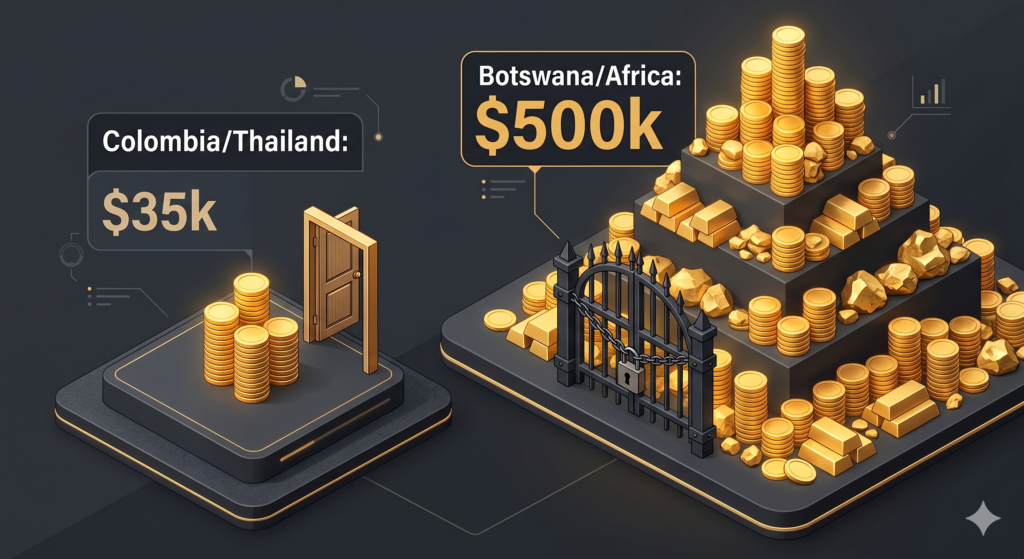
Colombia’s Migrant Investor Visa — the Visa de Migrante Inversionista — requires a minimum investment of approximately 100 SMMLV (the legal minimum wage baseline), which translates to roughly $27,000–$35,000 USD depending on exchange rates. Full legal residency follows within two years. The process is documented, the thresholds are enforced as published, and Medellín has become a recognized hub for Black Diaspora entrepreneurs precisely because the entry architecture does not punish incremental capital deployment.
Thailand’s Long-Term Resident Visa, launched in 2022, targets remote professionals, investors, and retirees with a $500,000 minimum investment in Thai assets or government bonds — but it comes with a 17% flat income tax rate, a 10-year renewable visa, work permits, and a fully staffed government concierge desk. Vietnam offers business investment visas tied to capitalization levels starting below $50,000 USD for most sectors, with land lease rights and sector-specific incentive packages.
Portugal’s now-restructured Golden Visa program maintained real estate entry points below €350,000 in designated interior regions, and Spain’s non-lucrative residence visa requires proof of approximately €2,300 per month in passive income — not a lump-sum capital deposit.
None of these jurisdictions are building equity with a historical Diaspora. None of them have a moral obligation rooted in centuries of involuntary displacement. All of them are beating Africa on price, process transparency, and execution speed.
The result is not theoretical. Pan-African professionals with operational capital in the $50,000–$200,000 range — precisely the tier that should be building agro-processing SMEs in Nairobi, Accra, and Gaborone — are building those businesses in Medellín and Bangkok instead. The ecosystem follows the entry architecture. Africa is exporting its own Diaspora development capital to competitor jurisdictions.
Section 3: Restorative Justice vs. Extractive Bureaucracy
The AU’s recognition of the 6th Region carries an implicit argument: that Descendants of Enslaved Africans occupy a categorically different position than general foreign investors. The argument is not only moral — it is policy-coherent. The Diaspora did not leave voluntarily. The forced displacement of millions across the Atlantic was an economic extraction event of historic scale. The wealth generated from that labor underwrote the industrialization of the Western hemisphere. The communities left behind — and the descendants produced from that rupture — have legitimate claims that exist outside the normal foreign investment framework.
The entry fee was paid in blood. The residency should not cost a fortune.
CRDEA’s policy position, articulated in its Diaspora Repatriation and Investment Framework (DRIF), is that Descendants of Enslaved Africans should be eligible for a distinct investment tier — one that recognizes ancestral claim as a form of stakeholder equity and adjusts financial thresholds accordingly. This is not charity. It is structural correction. The same logic that underpins tax incentives for returning nationals in Ireland, Israel’s Law of Return, and India’s OCI (Overseas Citizenship of India) scheme applies here with arguably greater historical justification.
Instead, what Diaspora investors frequently encounter is the opposite logic: that the emotional and historical weight of return should translate into a premium, not a discount. The assumption — rarely stated explicitly but operationally embedded — is that Diaspora investors will pay more because they are motivated by something beyond pure financial calculus. That motivation is exploited rather than honored.
The result is a bureaucratic posture that treats returning Descendants not as stakeholders in a shared economic project, but as a niche segment of the foreign cash cow category. High thresholds. Minimal facilitation. Maximum friction. And a political class that will photograph itself at Diaspora forums while the investment promotion agencies responsible to that same political class maintain $500,000 floors that exclude the very constituency being celebrated on stage.
This is not ambiguity. It is contradiction at the institutional level, and it has policy consequences that compound annually.
Section 4: The Solution — The DRIF and ADSII Frameworks
CRDEA’s position is not simply critical. The organization has developed two operational frameworks designed to provide African governments with the architecture needed to convert Diaspora goodwill into structured, scalable capital deployment.
The Diaspora Repatriation and Investment Framework (DRIF) proposes a tiered investment classification system with three entry categories:
Tier 1 — Ancestral Investor (AI) Class: For Descendants of Enslaved Africans with documented heritage or credentialed Diaspora affiliation, a minimum investment threshold of $30,000–$75,000 USD, with access to a dedicated facilitation desk, 90-day residency on arrival, and a 24-month pathway to long-term investor residency. Priority sectors include agro-processing, food manufacturing, hospitality SMEs, and technology-enabled agriculture.
Tier 2 — Pan-African Diaspora (PAD) Class: For African Diaspora nationals (citizens of African nations residing abroad) investing in a country other than their country of origin, thresholds calibrated to published sector minimums with government-backed facilitation guaranteed at the published figure — not a figure disclosed only upon engagement.
Tier 3 — General Foreign Direct Investment: Standard framework, unchanged, for non-Diaspora investors.
The African Diaspora SME Investment Index (ADSII) provides a scoring methodology for evaluating investment climate quality specifically from the perspective of the returning Diaspora SME operator. It measures published vs. operational thresholds, facilitation responsiveness, transparency of the land access process, and legal framework predictability. The index is designed to create comparative accountability — not unlike Transparency International’s Corruption Perceptions Index — giving Diaspora investors the data infrastructure to allocate capital based on verified, rather than marketed, conditions.
Both frameworks have been shared with relevant AU bodies and are available for consultation with national investment promotion agencies. They are not positioned as external critique. They are offered as technical instruments for governments that have stated publicly they want Diaspora capital and need a credible, executable framework for receiving it.
The frameworks exist. The political will to implement them is the outstanding variable.
Conclusion: A Warning to African Heads of State

The window for Africa to capture its Diaspora dividend is not permanently open. It operates on the same logic as any competitive investment market: mobile capital goes where friction is lowest and the entry architecture is most credible.
Right now, that friction calculus favors Medellín over Gaborone. Bangkok over Nairobi. Lisbon over Accra — ironic, given the history, but accurate given the operational reality. African governments have a finite period in which the historical and emotional pull of return retains enough weight to offset the structural disadvantages of high thresholds, opaque processes, and inconsistent facilitation. That period is not indefinite.
The Diaspora professional who arrived at BITC with a viable agro-processing plan, a credentialed operations background, and a genuine intent to establish long-term roots in Botswana walked away with a $500,000 quote. He is now evaluating Ghana and Kenya, where different facilitation dynamics may produce a different outcome. If those alternatives also fail to deliver a credible framework at a viable threshold, the capital does not disappear — it redirects to a jurisdiction that has figured out what Africa’s investment promotion agencies have not: that accessibility at the entry level is a strategic asset, not a concession.
AU Agenda 2063 commits Africa to being “an integrated, prosperous and peaceful Africa, driven by its own citizens.” The 6th Region is ready to be part of that project. The question is whether the national bureaucracies responsible for operationalizing that commitment will meet the moment — or continue to set prices that ensure the answer is no.
The Diaspora does not need Africa to give it anything. It needs Africa to stop pricing it out.
CRDEA — Coalition for the Repatriation of Descendants of Enslaved Africans — publishes policy research on Diaspora investment frameworks, Right of Return legislation, and SME development across the African continent and Caribbean. DRIF and ADSII framework documents are available upon request at crdea.com.
References: AU Agenda 2063 (African Union Commission, 2015); BITC Investment Framework Guide (Botswana Investment and Trade Centre, 2022); CRDEA Policy White Papers: Diaspora Repatriation and Investment Framework (DRIF) and African Diaspora SME Investment Index (ADSII).