One Sky Africa: The Single African Air Transport Market and Why It’s Needed Now
Africa is the second-largest continent on earth by land mass and population. It holds 54 recognized nations, over 1.4 billion people, and some of the fastest-growing economies in the world. Yet today, if you want to fly from Lagos to Nairobi — two cities on the same continent separated by roughly the same distance as London to Cairo — there is a reasonable chance your ticket will route you through Paris, Dubai, or Addis Ababa, cost you more than a transatlantic fare, and consume the better part of a full day in transit. This is not an accident of geography. It is the direct consequence of a colonial-era aviation system that was never dismantled.
The Single African Air Transport Market, formally known as SAATM and often called One Sky Africa, is the African Union’s landmark initiative to change that reality permanently. Launched officially at the AU Summit in Addis Ababa in January 2018, SAATM is designed to replace the web of restrictive bilateral aviation agreements that currently govern African skies with a single, liberalized, continent-wide air transport market. The vision is simple: African airlines should be free to fly between any two African countries with the same ease that airlines operate within the European Union or across the United States.
This article explains what SAATM is, why it has taken so long, what is at stake if it fails — and why full implementation is not optional for African development, Pan-African unity, or diaspora reconnection.
What Is the Single African Air Transport Market and How Did It Begin?
The roots of One Sky Africa do not begin in 2018. They stretch back to November 1999, when African transport ministers gathered in Yamoussoukro, Côte d’Ivoire, and adopted what became known as the Yamoussoukro Decision — a binding continental agreement calling for the full liberalization of African air transport. That agreement recognized a fundamental truth: Africa could not integrate politically or economically while its skies remained balkanized by colonial-era bilateral treaties, many of which were negotiated between newly independent African governments and their former colonial powers, often to protect European carrier interests rather than African ones.
The Yamoussoukro Decision was visionary. It was also, for nearly two decades, largely ignored. Implementation was blocked by a combination of national protectionism, undercapitalized national carriers, weak regulatory institutions, and a lack of political will. Individual countries feared opening their airspace would collapse their struggling national airlines before those airlines had time to grow.
When the African Union formally launched SAATM in 2018, it did so with a renewed political commitment and a clearer implementation framework built on the foundations of Yamoussoukro. Under SAATM, participating member states agree to grant each other’s airlines Fifth Freedom traffic rights — the right to carry passengers between two foreign countries as part of a longer international flight — and to eliminate protectionist restrictions on routes, frequencies, and pricing. As of recent years, more than 35 AU member states have signed on to the commitment in principle. The gap between that signature and operational reality, however, remains wide.
Why Are Intra-African Flights So Expensive and Difficult Today?
The dysfunction of African aviation today is measurable in numbers that should embarrass any institution claiming to support African development. Africa accounts for approximately 17 percent of the world’s population but generates barely 2 percent of global air traffic, according to the International Air Transport Association (IATA). Intra-African routes are consistently among the most expensive per kilometer anywhere on earth.
The reasons are structural and deliberately maintained:
- Bilateral Air Services Agreements (BASAs): Most African countries still operate under bilateral deals that restrict which airlines can fly which routes, how many flights are permitted, and what prices are acceptable. These agreements protect monopoly positions and suppress competition.
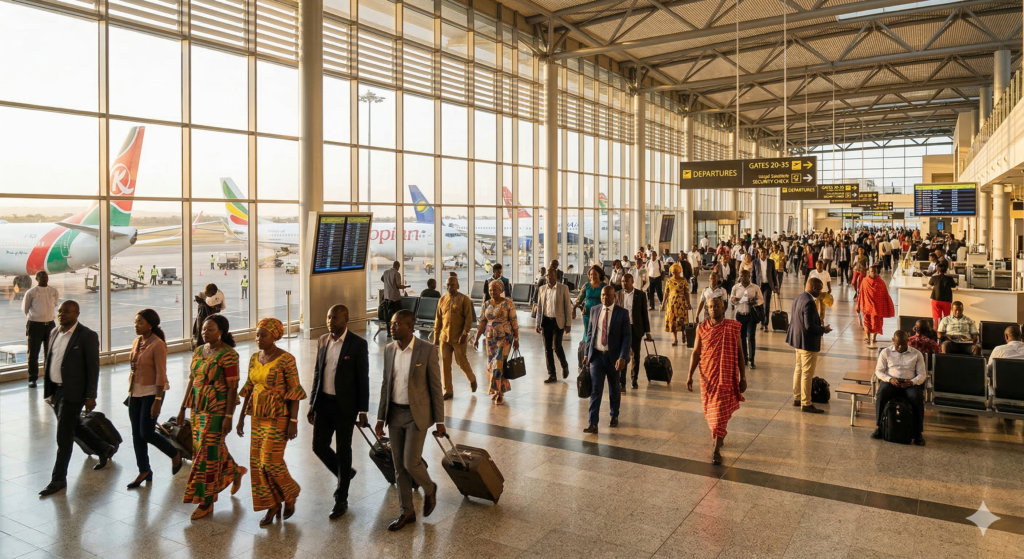
- Over-reliance on hub connectivity through non-African cities: European and Gulf carrier hubs — Paris Charles de Gaulle, London Heathrow, Dubai — have long served as transfer points for intra-African journeys, capturing revenue that should circulate within Africa and adding hours of unnecessary travel time.
- Underinvestment in African carrier capacity: Many African airlines lack the aircraft, capital, and route networks to compete on a liberalized market, which creates legitimate political resistance from governments that fear opening up.
- Poor airport infrastructure: A liberalized market means little if airports lack the capacity, customs efficiency, or ground handling services to support increased traffic.
- Non-standardized visa regimes: Aviation liberalization without complementary reform of intra-African visa policy creates a ceiling on demand. Africans remain among the most visa-restricted people on earth, even when traveling between African countries.
The cumulative effect is a continent where trade, tourism, and human movement are physically expensive in ways that serve external interests far more than African ones.
Why Does One Sky Africa Matter for Pan-African Economic Integration?
The African Continental Free Trade Area — AfCFTA — is the most ambitious trade integration project in African history. When fully operational, it will create a single market of over 1.4 billion consumers with a combined GDP approaching $3.4 trillion. It represents the economic backbone of African sovereignty in the 21st century.
But AfCFTA cannot reach its potential without functioning air connectivity. Trade in goods moves by road, rail, and sea. Trade in services, which represents some of the highest-value economic activity in the modern economy — finance, technology, professional services, consulting, media, creative industries — moves by air. Entrepreneurs cannot build regional businesses without the ability to travel affordably between markets. Investors cannot assess opportunities they cannot physically reach at reasonable cost and time.
SAATM is, in this sense, the physical infrastructure of economic Pan-Africanism. Without it, AfCFTA risks becoming a framework that benefits those with already-established capital and mobility — multinational corporations and foreign investors who can absorb high travel costs — while leaving small and medium African businesses trapped by geography.
The African Development Bank and the UN Economic Commission for Africa have both modeled the potential gains from full aviation liberalization. Estimates suggest full SAATM implementation could generate over 300,000 direct aviation-sector jobs and more than 2 million indirect jobs across the continent, add billions to GDP, and dramatically increase intra-African trade volumes. These are not speculative figures. They are extrapolations from what happened in regions — Europe, Southeast Asia, North America — where aviation liberalization was actually completed.
How Does the Single African Air Transport Market Affect the African Diaspora?
For the African diaspora — particularly descendants of the Transatlantic Slave Trade living in the Americas, the Caribbean, and Europe — the cost and complexity of traveling to Africa is a practical barrier to reconnection, investment, and repatriation. It is one thing to speak of the right of return as a political and cultural principle. It is another to make that return financially and logistically accessible to people who may be working-class or middle-income professionals exploring a new life on the continent.
Today, a diaspora African traveling from Atlanta to Accra often pays a competitive fare because that is a high-demand, well-served transatlantic route. But the same person seeking to then travel from Accra to Lagos, Dakar to Yaoundé, or Johannesburg to Lusaka frequently pays fares that are disproportionate to the distance involved and encounters routing that adds unnecessary complexity. If the vision of diaspora repatriation is to be more than rhetoric, African aviation infrastructure must support it practically.
One Sky Africa, when fully implemented, creates the conditions for new low-cost African carriers to emerge and compete on intra-continental routes, as happened in Europe with the liberalization that made carriers like Ryanair and EasyJet viable. It creates hubs that can grow into genuine continental transfer points — Addis Ababa, Nairobi, Lagos, Casablanca — that capture diaspora travel spending within Africa rather than routing it through European and Gulf airports. It makes the physical act of exploring, investing in, and returning to Africa cheaper and more possible for millions of people who carry African heritage and are being encouraged to consider that heritage as a living relationship, not merely a historical identity.
What Is Blocking Full Implementation and What Needs to Happen?
More than seven years after the formal launch of SAATM, full operational implementation remains incomplete. Understanding the obstacles is necessary for understanding what political pressure and policy action must achieve.
The primary barriers are not philosophical — virtually no African government publicly argues against aviation liberalization in principle. The barriers are institutional, economic, and political:
Several major African aviation markets, including Nigeria and South Africa, have historically moved slowly on implementation, in part because their national carriers — Air Nigeria in various iterations, South African Airways — have faced their own financial crises that make open competition a domestic political vulnerability. No government wants to be seen accelerating the collapse of a struggling national airline.
Regulatory harmonization across 54 countries is genuinely complex. Safety standards, aircraft certification, airworthiness regulations, and consumer protection frameworks vary significantly. The African Civil Aviation Commission (AFCAC) is the coordinating body but remains under-resourced relative to the scale of the task.
Airport infrastructure in many secondary African cities is insufficient to handle significant increases in traffic without investment in terminals, runways, air traffic management systems, and ground services. Aviation liberalization without this investment creates bottlenecks that frustrate rather than enable growth.
What is required is a combination of things that African institutions and AU member states are capable of delivering when political will is genuinely applied: accelerated regulatory harmonization through AFCAC, dedicated infrastructure investment through the African Development Bank and national development finance institutions, the negotiation of complementary intra-African visa liberalization agreements, and direct support for the capitalization of competitive African carriers capable of operating on liberalized routes profitably.
The AU’s Agenda 2063 identifies SAATM as a flagship project. That designation must translate into the kind of sustained, funded, accountable implementation program that flagship status implies — not simply a recurring agenda item at summits where commitment is expressed and then deferred.

Why the Time for One Sky Africa Is Right Now
The arguments for urgency are not manufactured. They reflect the intersection of several forces that make this moment distinctive.
AfCFTA is operational and generating early trade activity that needs air connectivity to scale. The post-pandemic recovery of global aviation has created a window in which route networks are being rebuilt and redefined — African policymakers and carriers that act now can shape those networks rather than inheriting the legacy structure. Several competitive African carriers, including Ethiopian Airlines — the most profitable airline in Africa and one of the fastest-growing in the world — have demonstrated that African aviation excellence is real and scalable when the institutional environment supports it. Ethiopian Airlines now serves more African destinations than any other carrier on earth. It is proof of concept for what a liberalized continental market could produce across multiple hubs and multiple carriers.
The diaspora is more engaged with African development than at any point since the independence era. Investment, repatriation interest, political advocacy, and cultural reconnection are all rising. The infrastructure to support that engagement must rise alongside it.
One Sky Africa is not a luxury program for a distant and wealthier version of the continent. It is a foundational policy requirement for everything else that Pan-African ambition demands — integrated economies, sovereign development, accessible return, and the physical expression of a unity that has been declared in principle for over sixty years. The sky above Africa should belong, operationally and economically, to Africa. The tools, the agreements, and the political mandate to make that real already exist. What is required now is the discipline to finish what was started.
CRDEA.com is committed to advancing policy frameworks that support African sovereignty, diaspora reconnection, and Pan-African development. If this article informed your thinking, share it and explore our resources on repatriation policy, African investment, and the right of return.