The Sixth Region, Priced at the Gate: Why African Diaspora Investment Keeps Bypassing Africa
By the CRDEA Policy Team
There is a quiet contradiction running through Africa’s relationship with its diaspora. The African Union has, since 2003, formally designated the global African diaspora as the continent’s Sixth Region — a constituency invited, in the express language of Article 3(q) of the Constitutive Act, to take “full participation” in building the Union.1 In 2026 the AU went further, endorsing a Diaspora Legal Framework that finally allocates twenty seats to diaspora civil-society organisations within ECOSOCC, ending more than two decades of symbolic recognition without a mechanism.2
And yet, at the national level — where investment permits are issued, where land is titled, where a returning entrepreneur actually has to register a company — the descendant of enslaved Africans is treated as an ordinary foreign national. Worse, in capital terms, they are treated as a multinational. This is the gap the African Diaspora SME Investment Initiative (ADSII) exists to close.
This article sets out what ADSII actually is, the specific legal barriers it responds to, and why a modest, tightly governed pilot is the most realistic path from the rhetoric of the Sixth Region to its reality.
The barrier, stated plainly
Take Kenya, because it is concrete and well-documented. The principal route for a foreign entrepreneur is the Class G Investor Permit, governed by the Kenya Citizenship and Immigration Act, 2011.3 The Act itself only requires “sufficient capital.” In practice, the Directorate of Immigration Services has set an effective benchmark of USD 100,000 of verifiable capital, deposited in a Kenyan account, before a permit is granted — with an annual issuance fee of KES 250,000 on top.4
That figure is not calibrated for the people the Sixth Region is supposed to welcome. A Black-American or Black-British entrepreneur planning a poultry operation, an agro-processing unit, or a market-garden venture is deploying capital incrementally — typically in the USD 30,000–50,000 range — into productive assets, not parking six figures in a holding account to satisfy an immigration officer. The threshold does not distinguish between a returning descendant building a livestock enterprise and a foreign conglomerate seeking extraction rights. Both face the same wall.
The contrast with the destinations actually capturing this capital is stark.
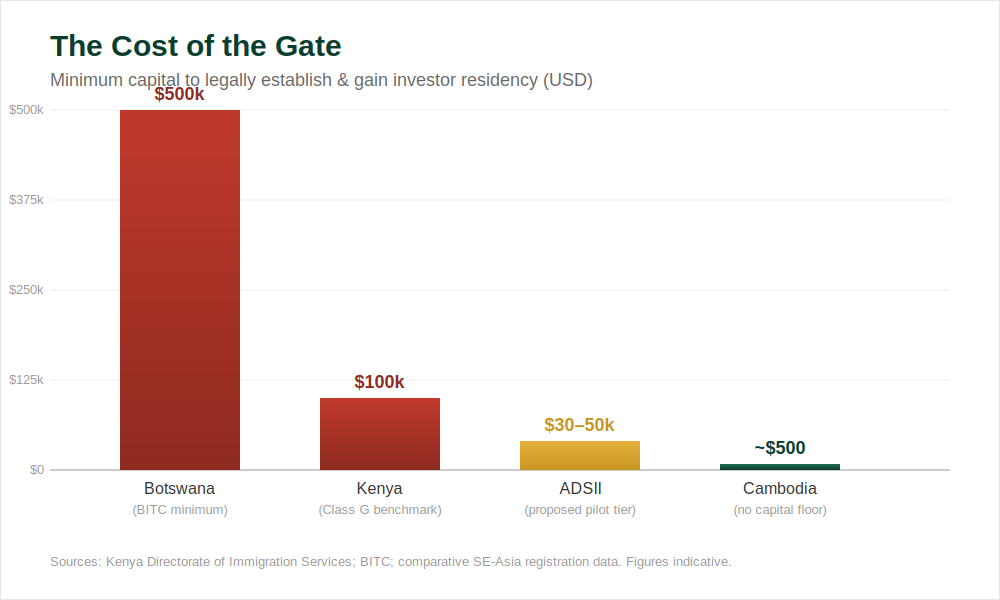
Botswana’s investment agency has cited a USD 500,000 minimum for foreign business establishment.5 Meanwhile a 100%-foreign-owned company can be registered in Cambodia for a few hundred dollars with no minimum capital requirement. The diaspora entrepreneur is not choosing Southeast Asia because they prefer it to the continent of their ancestry. They are choosing it because Africa has, at the administrative level, priced them out.
The land dimension — a second, quieter wall
Immigration is only half the story. Even an entrepreneur willing to clear the capital bar runs into Kenya’s constitutional treatment of land. Article 65 of the Constitution of Kenya, 2010 provides that a non-citizen may hold land only on leasehold tenure, capped at ninety-nine years; any instrument purporting to grant more is automatically reduced to a 99-year lease.6 Critically for the diaspora investor structuring through a company, Article 65(3) deems a company a “citizen” only if it is wholly owned by Kenyan citizens — so a single foreign shareholder converts the entity to a non-citizen, subject to the leasehold cap and, for agricultural land, the consent regime of the Land Control Act.7
This is not an argument against investing — leasehold tenure of ninety-nine years is, for most agribusiness purposes, a perfectly workable horizon, and the asset remains real and bankable. But it underlines the central point: the legal architecture was built to manage foreign capital, and it makes no distinction for a population the AU itself has defined as part of the continent. ADSII is the proposal to build that distinction.
What ADSII Proposes for African Diaspora Investment
ADSII is a programme of CRDEA. It is deliberately not a demand for citizenship, for permanent policy change, or for preferential treatment in the sense critics fear. It is a request for a controlled, revocable, performance-based pilot that lets a host government test a specific proposition: whether modest diaspora SME investment, properly governed, delivers measurable national benefit.
The recommended default parameters — every one of them negotiable with the host state — are:
- A qualifying investment tier of USD 30,000–50,000, recognising SME-scale realities rather than multinational-scale capital.
- A focus on agriculture, agro-processing, livestock and rural value chains — precisely the sectors underserved by large foreign direct investment.
- Asset-based recognition: land positions, livestock, poultry or processing units and equipment may count toward the threshold, subject to independent verification.
- Mandatory documented local partnership, with priority given to women-led enterprises.
- A hard cap of roughly 30–100 investors over a 12–18 month evaluation window.
- Full revocability — residency is conditional, reviewed quarterly against real metrics, and can be withdrawn for non-performance.
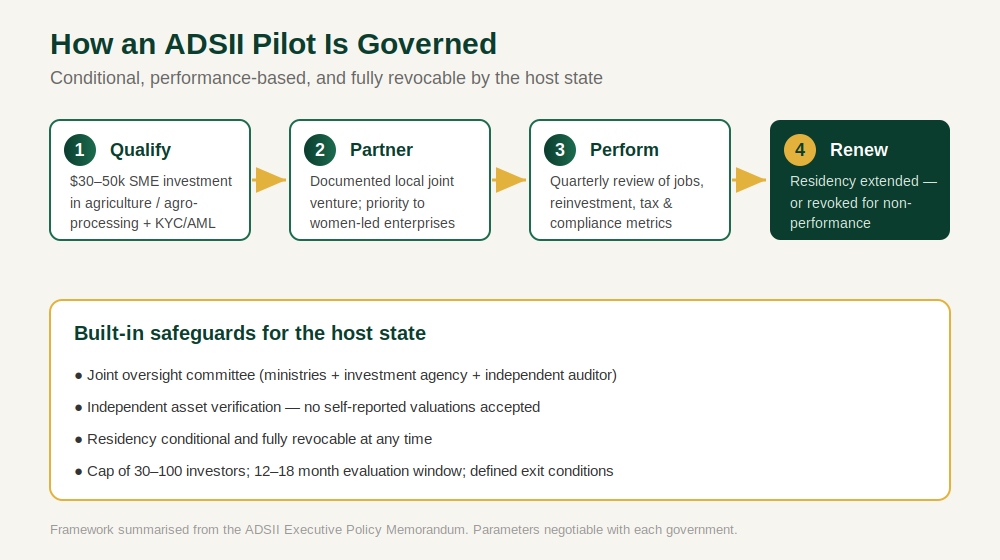
The governance is the point. A joint oversight committee — drawn from the relevant ministries, the national investment-promotion agency and an independent auditor — reviews applications and monitors compliance. Asset valuations are independently verified; no self-reporting is accepted. Residency is tied to quarterly indicators: full-time jobs created, share of profit reinvested locally, partnership compliance, and tax and environmental standing. An investor who does not perform does not renew. The state commits to nothing permanent and can end the pilot on defined exit conditions.
Why a pilot, and not a manifesto
The temptation in diaspora advocacy is to demand sweeping legislative change. That approach reliably fails, because it asks a government to over-commit on the basis of sentiment. ADSII inverts the logic. It hands the host state a low-risk instrument to generate its own evidence — empirical data on how diaspora SME investors actually behave — before any permanent commitment is contemplated. For a finance or interior ministry, that is a far easier “yes.”
It also has precedent on its side. Ancestry- and diaspora-linked residency frameworks are well established in international practice — Ghana’s Right of Abode and Year of Return programming, Portugal’s pathway for Sephardic descendants, Israel’s Law of Return, and the CARICOM reparatory-justice framework all rest on the same principle: that a population with a severed historical tie to a territory is not, in policy terms, the same as an unrelated foreign national.8 ADSII asks African states only for parity with norms they already recognise elsewhere.
The economic case the continent keeps missing
The cost of the status quo is not abstract. Ghana’s 2019 Year of Return generated roughly USD 1.9 billion in economic activity from a single coordinated campaign — and that was the tourism floor, not the deeper return from people who stay and build.9 CRDEA’s own modelling places the annual capital that Sub-Saharan Africa loses to Southeast Asia, Eastern Europe and Latin America — across heritage tourism, business formation, local consumer spending and property investment — at a conservative USD 4.5–11 billion, compounding toward USD 60 billion-plus over a decade.
For the diaspora entrepreneur weighing these markets, the maths is rarely emotional and almost always operational: what will it cost to land goods, clear customs, and actually run margin in each jurisdiction? Those landed-cost differences across African markets are exactly what tools like the MetricSuite Import Duty Calculator were built to expose — and they consistently show why capital routes to where the friction is lowest.10 Policy sets the gate; cost structure decides where the entrepreneur walks through.
From the Sixth Region in name to the Sixth Region in fact
The African Union has done the conceptual work. It has named the diaspora a region of the continent and, in 2026, finally given it a seat. What remains undone is the unglamorous, national-level administrative reform that would let a descendant of enslaved Africans register a small agribusiness and obtain residency without being asked for a multinational’s balance sheet.
ADSII is the bridge between those two facts. It is modest by design, governed to the host state’s advantage, and evidence-generating rather than commitment-demanding. The question it puts to African governments is simple: having declared the diaspora your Sixth Region, will you let them through the gate — on terms you fully control — or will you keep watching their capital build someone else’s economy?
CRDEA — the Coalition for the Repatriation of Descendants of Enslaved Africans — advocates for the legal, economic and cultural recognition of the African diaspora’s right to return, invest and build on the continent. Governments and institutions seeking a briefing on the ADSII pilot framework can request one here.
Notes & References
- African Union, Constitutive Act, Article 3(q); diaspora formally declared the Sixth Region, 2003. AU ECOSOCC, “The African Diaspora’s Seat at the Table.” ecosocc.au.int ↩
- African Union, 2026 Diaspora Legal Framework and Diaspora Report; allocation of 20 ECOSOCC General Assembly seats to diaspora CSOs. ecosocc.au.int ↩
- Kenya Citizenship and Immigration Act, 2011, and Regulations, 2012; Class G defined as a specific trade, business or consultancy requiring “sufficient capital.” Directorate of Immigration Services. fns.immigration.go.ke ↩
- Effective USD 100,000 capital benchmark and KES 250,000 annual issuance fee per Directorate of Immigration Services practice (2026). WKA Advocates. ↩
- Botswana Investment and Trade Centre minimum threshold of USD 500,000 for foreign business establishment, as reported through CRDEA direct outreach. ↩
- Constitution of Kenya, 2010, Article 65(1)–(2). Kenya Law Reform Commission. klrc.go.ke ↩
- Constitution of Kenya, 2010, Article 65(3); a body corporate is a “citizen” only if wholly owned by citizens. Land Control Act (Cap 302) governs agricultural-land transactions. The Lawyer Africa. ↩
- Comparative ancestry- and diaspora-linked frameworks: Ghana (Right of Abode / Year of Return), Portugal (Sephardic nationality law), Israel (Law of Return), CARICOM Reparatory Justice Framework. ↩
- Ghana Tourism Authority, Year of Return 2019 economic-impact figures (~USD 1.9 billion; ~760,000 visitors). ↩
- MetricSuite Import Duty Calculator — landed-cost, duty and VAT modelling across major African markets. metricsuite.tools ↩